← #nieuws

Synaffix Announces License Agreement with Mersana Therapeutics

Synaffix has entered into a license agreement with Mersana Therapeutics,  a clinical-stage biopharmaceutical company focused on discovering and developing a pipeline of antibody drug conjugates (ADCs) targeting cancers in areas of high unmet need. This agreement provides Mersana access to Synaffix’s industry-leading site-specific GlycoConnect™ ADC technology that has consistently demonstrated an ability to improve both the safety and the efficacy profiles of ADC product candidates. Synaffix is eligible to receive upfront and milestone payments on a per-target basis with a projected total deal value of $295 million, plus royalties.

Under the terms of the agreement, Mersana has been granted a non-exclusive license to incorporate GlycoConnect™ into one of its ADC development candidates, as well as an option to expand to additional programs. This agreement follows a research collaboration between the two companies that was centered around multiple product candidates.

“After evaluating several site-specific conjugation platforms, we have chosen Synaffix’s GlycoConnect™ technology for use in future ADC candidates,” said Anna Protopapas, President and Chief Executive Officer of Mersana. “We are excited about the potential of this technology as it is designed not to require additional antibody engineering or cell-line modifications, which would offer us the potential to create site-specific antibodies for use in our ADCs when required.”

“We are particularly excited to enter into this agreement with a leading company in the field of ADCs such as Mersana,” said Peter van de Sande, CEO of Synaffix, who added “This collaboration is another testimony of the additional value that GlycoConnect™ is able to provide to already cutting-edge ADC technologies, thereby enabling novel medicines that are uniquely positioned to address areas of unmet medical need.”

Per the agreement, Mersana is responsible for the research, development, manufacturing and commercialization of any resulting ADC product while Synaffix will supply components that are specifically related to its proprietary GlycoConnect™ technology.

Source: Synaffix press release

← #nieuws

Fibrocor and Galapagos sign partnership in fibrosis

,

Fibrocor Therapeutics, a privately held Canadian company, and Galapagos announced a global partnership focused on a novel target for idiopathic pulmonary fibrosis (IPF) and other indications.

Fibrocor specializes in the development of tissue-specific therapeutics to treat the underlying cause of fibrotic diseases of the kidney and other organs. The collaboration announced today concerns a small molecule inhibitor program, currently in the lead optimization stage of development for the treatment of fibrotic diseases of the lung and other organs, the target of which is undisclosed. In exchange for global commercialization rights to Galapagos, Fibrocor will receive an upfront payment, and potentially is eligible for further milestone and royalty payments. Galapagos will be responsible for all further development of the program.

“This collaboration validates the fibrosis drug development expertise of Fibrocor,” says Mark A. Steedman, President and CEO of Fibrocor. “I take my hat off to Dr. Richard Gilbert and the scientific team, including Evotec GmbH, our CRO1 partner, for establishing a compelling data package that ultimately attracted Galapagos, a world-renowned biotech company with a key franchise in fibrosis. We feel this is the beginning of a great relationship and look forward to working with Galapagos to the benefit of fibrosis sufferers everywhere.”

“The collaboration with Fibrocor announced today is an excellent strategic fit for Galapagos, as we continue to expand our franchise in IPF, and more broadly, in fibrosis,” says Dr. Piet Wigerinck, Chief Scientific Officer at Galapagos. “We are enthusiastic about the drug discovery approach at Fibrocor, and look forward to collaborating with the team to address the large unmet medical need in fibrosis.”

Source: Galapagos

← #nieuws

ProQR Receives Fast Track Designation from FDA for QR-421a for Usher Syndrome Type 2

,

ProQR has received a Fast Track designation from the Food and Drug Administration (FDA) for QR-421a. QR-421a is a first-in-class investigational RNA-based oligonucleotide designed to address the underlying cause of the vision loss associated with Usher syndrome type 2 and non-syndromic retinitis pigmentosa (RP) due to mutations in exon 13 of the USH2A gene.

Fast Track designation is granted by FDA to drugs that are under development for serious conditions and have the potential to fulfill an unmet medical need. It was established with the intention to bring promising drugs to patients sooner by facilitating the development with more frequent FDA interactions and expediting the review process.

“We are very pleased with the Fast Track designation the FDA granted us for QR-421a. Patients with Usher syndrome, the leading cause of combined deafness and blindness, currently have no available therapies for their vision loss and this designation emphasizes the high unmet need in this disease,” said Daniel de Boer, Chief Executive Officer of ProQR. “We are also looking forward to begin enrollment in the Phase 1/2 STELLAR clinical trial in the coming months with preliminary data expected in mid-2019.”

Source: ProQR

← #nieuws

Bristol-Myers Squibb acquires Celgene

Bristol-Myers Squibb and Celgene have entered into a definitive merger agreement under which Bristol-Myers Squibb will acquire Celgene in a cash and stock transaction with an equity value of approximately $74 billion.

Under the terms of the agreement, Celgene shareholders will receive 1.0 Bristol-Myers Squibb share and $50.00 in cash for each share of Celgene. Celgene shareholders will also receive one tradeable Contingent Value Right (CVR) for each share of Celgene, which will entitle the holder to receive a payment for the achievement of future regulatory milestones. The Boards of Directors of both companies have approved the combination.

The transaction will create a leading focused specialty biopharma company well positioned to address the needs of patients with cancer, inflammatory and immunologic disease and cardiovascular disease through high-value innovative medicines and leading scientific capabilities. With complementary areas of focus, the combined company will operate with global reach and scale, maintaining the speed and agility that is core to each company’s strategic approach.

Based on the closing price of Bristol-Myers Squibb stock of $52.43 on January 2, 2019, the cash and stock consideration to be received by Celgene shareholders at closing is valued at $102.43 per Celgene share and one CVR (as described below). When completed, Bristol-Myers Squibb shareholders are expected to own approximately 69 percent of the company, and Celgene shareholders are expected to own approximately 31 percent.

“Together with Celgene, we are creating an innovative biopharma leader, with leading franchises and a deep and broad pipeline that will drive sustainable growth and deliver new options for patients across a range of serious diseases,” said Giovanni Caforio, M.D., Chairman and Chief Executive Officer of Bristol-Myers Squibb. “As a combined entity, we will enhance our leadership positions across our portfolio, including in cancer and immunology and inflammation. We will also benefit from an expanded early- and late-stage pipeline that includes six expected near-term product launches. Together, our pipeline holds significant promise for patients, allowing us to accelerate new options through a broader range of cutting-edge technologies and discovery platforms.”

Dr. Caforio continued, “We are impressed by what Celgene has accomplished for patients, and we look forward to welcoming Celgene employees to Bristol-Myers Squibb. Our new company will continue the strong patient focus that is core to both companies’ missions, creating a shared organization with a goal of discovering, developing and delivering innovative medicines for patients with serious diseases. We are confident we will drive value for shareholders and create opportunities for employees.”

“For more than 30 years, Celgene’s commitment to leading innovation has allowed us to deliver life-changing treatments to patients in areas of high unmet need. Combining with Bristol-Myers Squibb, we are delivering immediate and substantial value to Celgene shareholders and providing them meaningful participation in the long-term growth opportunities created by the combined company,” said Mark Alles, Chairman and Chief Executive Officer of Celgene. “Our employees should be incredibly proud of what we have accomplished together and excited for the opportunities ahead of us as we join with Bristol-Myers Squibb, where we can further advance our mission for patients. We look forward to working with the Bristol-Myers Squibb team as we bring our two companies together.”

Approvals and Timing to Close

The transaction is subject to approval by Bristol-Myers Squibb and Celgene shareholders and the satisfaction of customary closing conditions and regulatory approvals. Bristol-Myers Squibb and Celgene expect to complete the transaction in the third quarter of 2019.

Source: Celgene

← #nieuws

DegenRx secures funding for Alzheimer’s disease gene therapy

DegenRx, a biopharmaceutical company developing novel therapeutic solutions to treat neurodegenerative diseases, has secured financing for their antibody-based gene therapy program for the treatment of Alzheimer’s disease (AD).

Participating in this Series A financing are Swanbridge Capital and BOM Brabant Ventures, together with several private investors seasoned in the pharma and biotech industry. The company will be managed by Guus Scheefhals as Chief Executive Officer and Hans Preusting as Chief Development Officer. DegenRx aims to develop vector-based gene therapies for degenerative brain disorders, such as Alzheimer’s and Parkinson’s disease. Gene therapy aims to provide a potentially lifelong effect after a single administration. DegenRX will develop its proprietary, highly specific antibody, targeting and neutralizing toxic Alzheimer proteins in the brain that would thus slow down or ideally stop disease progression. The current funding will be used to demonstrate the feasibility of this approach in a pre-clinical model.

 Guus Scheefhals, CEO of DegenRx, commented: “We are very pleased that the investors are prepared to take on this early opportunity. Degenerative diseases are having an increasing impact on society and most still lack disease-modifying treatments. This investment enables us to show that our innovative approach can work. By making the active compound in the brain, we avoid the need to pass the blood-brain barrier which is typically a significant hurdle for most drugs and certainly for the larger ones, such as antibodies. We are very excited about the potential of our program and hope it will ultimately contribute to the urgently needed benefit for AD patients.”

Nicky Rijk-Vogels, fund manager at Swanbridge Capital: “In terms of phase and technology, DegenRx fits perfectly with the mission of Swanbridge Capital. Our goal is to ensure that young biotech companies can take the next step by providing them with the necessary venture capital and relevant support. We believe in the potential of gene therapy and are happy to contribute to the broader application that DegenRx has in mind for the treatment of degenerative brain diseases. ”

Mercedes Tuin, Investment Manager Life Sciences & MedTech at BOM Brabant Ventures: “BOM Brabant Ventures invests in Brabant companies that have the potential to become disruptive world players. DegenRx has that potential. With Guus Scheefhals and Hans Preusting as Chief Development Officer on board, we have every confidence that the DegenRx team will succeed in their mission.”

Source: DegenRx press release

← #nieuws

Xenikos will conduct Phase 3 trial to test T-Guard(R) in acute graft-versus-host disease

,

Xenikos has partnered with the Blood and Marrow Transplant Clinical Trials Network (BMT CTN) to conduct a U.S.-based Phase 3 registration trial to test the efficacy of T-Guard in treating steroid-refractory acute graft-versus-host disease (SR-aGVHD) in patients following an allogeneic stem cell transplant. Funded by the National Heart, Lung, and Blood Institute and the National Cancer Institute, both part of the National Institues of Health, the BMT CTN includes leading transplant centers in the United States (U.S.) and will provide a total of USD 1.37 million in funding for the T-Guard trial.

“At Xenikos, we see BMT CTN’s access to major transplant centers in the U.S., as well as their established track record for successfully recruiting patients with acute GVHD, and vast knowledge and expertise in this field, as aiding in the development of innovative new immunotherapies for improving patient outcomes” said Dr. Ypke van Oosterhout, CEO of Xenikos. “We are therefore confident that our partnership with BMT CTN will help bring T-Guard to transplant patients as quickly as possible.”

“Our network often conducts large, multi-institutional clinical trials in order to test new treatments designed to improve outcomes associated with hematopoietic stem cell transplantation or HSCT,” said Dr. Mehdi Hamadani of the BMT CTN. “Acute GVHD is a life-threatening complication of HSCT and better treatments are needed for our patients. The preliminary data obtained with T-Guard is quite promising, and we believe that the Phase 3 trial is the next logical step.”

The U.S.-based Phase 3 trial will be a multi-center study involving patients who have received an allogeneic stem cell transplant for a myeloid or lymphoid malignancy and subsequently developed SR-aGVHD. Importantly, the Phase 3 trial design is based on input received from the U.S. Food and Drug Administration at the End-of-Phase 2 meeting. Xenikos plans to file an Investigational New Drug application in 2019.

← #nieuws

Enpicom sets a new standard for B cell receptor repertoire analysis

,

The Dutch bioinformatics software engineering company ENPICOM announced that they have finalized development and released an expanded version of their ImmunoGenomiX (IGX) platform to support discovery and development of novel immunotherapies, patient stratification for, and treatment monitoring of immunotherapies. IGX now also accepts B cell receptor (BCR) in addition to T cell receptor (TCR) sequencing data. Head-to-head benchmarking studies versus world’s most popular tool, pRESTO, show superiority on several levels.

The improvements in high-throughput sequencing (HTS) technology provide unprecedented opportunities to explore the enormous diversity of the immune repertoire by deep sequencing T cell receptors and B cell receptors. However, an efficient, integrated, easy-to-use and accurate analytical tool required to process the huge amounts of immunosequencing data has so far been lacking.

With the IGX platform, ENPICOM is on a mission to provide the immunotherapy community with a best-in-class solution to analyze T cell and B cell receptor (TCR/BCR) immunosequencing data. The base module of the IGX platform to perform T cell receptor repertoire analysis, IGX Explore, was launched in August this year. The current functional expansion of IGX Explore adds support for the identification and quantification of B cell receptors (BCRs) from HTS data. Dr. Nicola Bonzanni, ENPICOM’s Chief Scientific Officer, commented: “As BCR analysis harbors additional complexities, such as immunoglobulin (Ig) (i.e. antibody) gene somatic hypermutations, the development of a state-of-the-art solution for Ig/BCR sequence analysis offered more extensive challenges for our bioinformatics and software engineering teams. It is with great pleasure that we announce the timely release of the next version of IGX Explore and that our benchmarking studies showed even better performance than expected.”

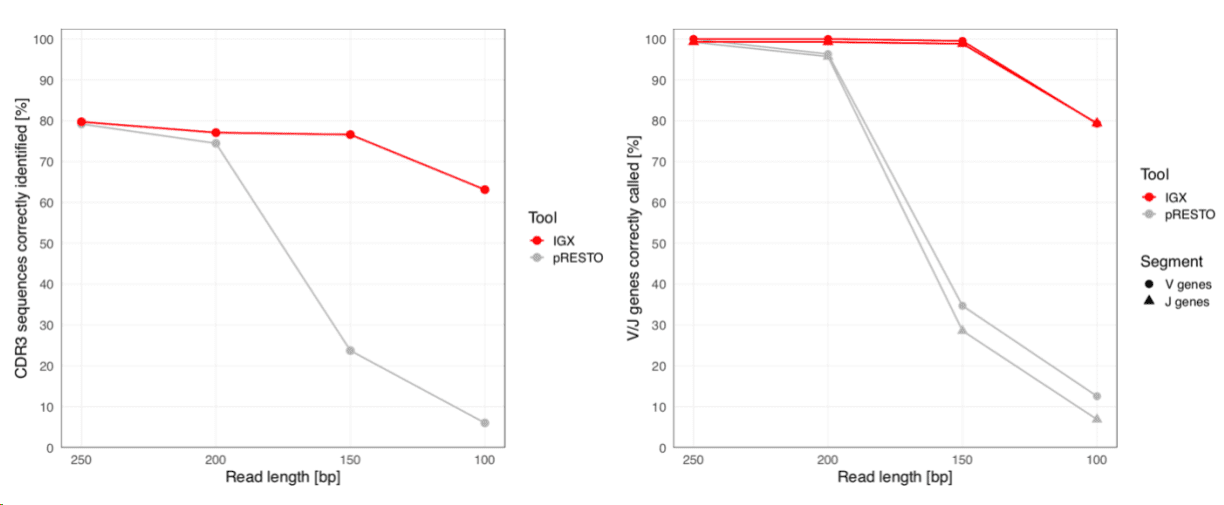
Dr. Bonzanni continues: “We benchmarked the performance of IGX Explore for BCRs using both synthetic and experimental datasets. IGX Explore shows superior performance for critical metrics such as correctly identified CDR3 sequences and V/J gene identification. Specifically, we compared IGX Explore with pRESTO (Vander Heiden, et al. 2014), the world’s most popular BCR sequencing analysis tool. On synthetic data, we show that IGX Explore achieves consistent and highly precise performance across all commonly used read lengths, and outperforms pRESTO at short reads lengths in particular, as visualized in the graphs below.

Furthermore, using an independently published experimental dataset (Meng W, et al. 2017), we showed that IGX Explore is able to recapitulate the reference immune repertoire composition with high accuracy. Finally, IGX Explore outperforms pRESTO with regards to speed and scalability”.

As announced before, the ImmunoGenomiX (IGX) platform will be modularly expanded to become a comprehensive end-to-end immunosequencing data analysis platform designed to analyze, monitor, and compare immune repertoires in the context of immunotherapy development and at all stages of treatment and disease over time. Starting from high-throughput sequencing data, it will deliver an easy-to-read report appropriate for the specific application, be it research, diagnosis, patient stratification, or treatment monitoring. The IGX platform will allow customers to select their own sample preparation protocols and the HTS technology of choice. It requires no programming skills as the interface is intuitive and flexible.

The complete base module, IGX Explore, is now available and can perform clonality analysis of both TCR and BCR repertoires starting from raw sequencing data, report back the number of individual TCR/BCR clones and interactively visualize them in a user-friendly way. With IGX Explore, immunotherapy companies can boost their target discovery, research and drug development processes. Tailored software extensions to answer specific research or clinical questions can be custom-built in collaboration with ENPICOM’s team of immunologists and bioinformaticians.

Using a recently published and independent benchmark, ENPICOM showed in August that IGX Explore offered superior accuracy on TCRs and the current benchmark studies complement this picture for BCRs. More information about these benchmark studies can be found at the company’s website and will be published in a white paper shortly.

Source: ENPICOM

← #nieuws

Staten Biotechnology and Novo Nordisk collaboration on novel treatment for dyslipidaemia

,

Staten Biotechnology and Novo Nordisk announced that they have entered into a collaboration and exclusive option agreement to develop novel therapeutics for the treatment of hypertriglyceridaemia.

Under the collaboration agreement, Novo Nordisk will provide research and development (R&D) funding and support for Staten to develop its lead asset STT-5058 for treatment of dyslipidaemia.

“Novo Nordisk is joining forces with Staten Biotechnology at an exciting time for us, with the company’s lead compound moving towards its first clinical trial, aiming to address the residual cardiovascular risk in patients with hypertriglyceridaemia,” said Dr Hilde Steineger, CEO of Staten Biotechnology. “This partnership provides the company not only with a knowledgeable development partner but also with a funding structure that allows founders, management and the founding investors to accelerate the development of company”.

“Our partnership with Staten Biotechnology is a key step in executing our strategic priority to expand into cardiovascular diseases. Hypertriglyceridemia is a serious risk factor for cardiovascular disease, in particular often present in people with diabetes and obesity. Staten Biotechnology has developed STT-5058, a new promising concept validated by human genetics, for the treatment of hypertriglyceridemia. Combining Staten’s know-how on STT-5058, the scientific excellence of the company’s executive team and founders, with Novo Nordisk experience in drug development and commercialization, the project holds potential to make a real difference for people suffering from cardiovascular disease,” said Marcus Schindler, Senior Vice President, Global Drug Discovery in Novo Nordisk.

Under the exclusive option agreement, Novo Nordisk has the right to acquire Staten Biotechnology and gain worldwide rights to STT-5058. Staten Biotechnology and its shareholders will potentially receive signing and exercise fees, R&D funding, and milestone payments of up to 430 million euros.

Source: Staten Biotechnology

← #nieuws

Minister Wiebes zet belang vestigingsklimaat op de kaart

,

Dinsdag verscheen een mooie brief van Minister Wiebes van Economische Zaken en Klimaat over de bijdrage van buitenlandse bedrijven aan de Nederlandse economie. Daarin besteedt Wiebes veel aandacht aan het belang van gerichte acquisitie van bedrijven die de Nederlandse kennispositie verder versterken, met daarin een prominente rol voor de life sciences.

De aantrekkelijkheid van Nederland voor investeringen van buitenlandse bedrijven hangt niet alleen af van goede acquisitie, maar staat of valt met een sterk vestigingsklimaat. Minister Wiebes geeft aan dat de overheid hierin moet blijven investeren omdat dat ten goede komt van alle bedrijven, klein en groot, die in Nederland ondernemen. Eén van de elementen daarin richt zich op de gaten in het financieringslandschap, waar Wiebes mogelijkheden ziet voor Invest-NL. Ook haalt de minister extra investeringen in onderwijs aan die moeten zorgen voor voldoende beschikbaarheid van geschikt personeel, nu en in de toekomst.

Lees de hele brief hier

← #nieuws

Innovatiekrediet klinische ontwikkeltrajecten omhoog naar € 30 miljoen

,

Voor een ijzersterk innovatieklimaat zijn voldoende financieringsmogelijkheden in de verschillende fases van ontwikkeling onontbeerlijk. HollandBIO maakt zich daarom hard voor een betere beschikbaarheid van financiering voor start-ups en scale-ups. Het is dan ook een flinke opsteker dat het budget voor klinische ontwikkeltrajecten met € 10 miljoen is opgehoogd tot € 30 miljoen. Een mooi resultaat waar HollandBIO zich jarenlang voor heeft ingezet. Het totale budget voor het Innovatiekrediet voor 2019 komt daarmee uit op € 60 miljoen.


Begin 2018 werd bekend dat het budget voor klinische projecten al op 1 januari flink was overvraagd. Het is daarom raadzaam om aanvragen op 1 januari 2019 in te dienen. Voor het in behandeling nemen van aanvragen is de dag van ontvangst van de aanvraag bepalend, en niet het tijdstip. Daarnaast is het belangrijk dat de aanvraag voor een Innovatiekrediet volledig wordt ingediend. Zie voor alle informatie over het Innovatiekrediet de website van RVO.

Gaten in financieringslandschap

Het financieringslandschap voor life sciences bedrijven vertoont nog flinke gaten. HollandBIO maakt zich binnen het programma ‘Een ijzersterk innovatieklimaat’ onder andere hard voor betere beschikbaarheid van kapitaal voor start-ups en scale-ups. We zien daarbij kansen voor de life sciences binnen de nieuw op te richten financieringsinstelling Invest-NL. Meer informatie vind je op onze website.

Zie ook:

https://www.hollandbio.nl/programmas/ijzersterk-innovatie-klimaat/

https://www.hollandbio.nl/nieuws/budgetuitputting-klinische-projecten-innovatiekrediet/