Deze missie is in aanwezigheid van Sigrid Kaag, minister voor Buitenlandse Handel en Ontwikkelingssamenwerking, Bruno Bruins, minister voor Medische Zorg en Sport, Mona Keijzer, staatssecretaris van Economische Zaken en Klimaat, Marjolijn Sonnema, directeur-generaal Agro van het ministerie van Landbouw, Natuur en Voedselkwaliteit en watergezant Henk Ovink.
Ineke Dezentjé Hamming-Bluemink is de zakelijk missieleider. Zij is bestuurslid van VNO-NCW en voorzitter van FME-CWM.
Deze missie loopt parallel aan het staatsbezoek van Zijne Majesteit Koning Willem-Alexander en Hare Majesteit Koningin Máxima aan India. De Koning en de Koningin nemen deel aan diverse programmaonderdelen van deze missie.
Evotec and Lygature announced their cooperation in a new initiative for the development of novel antibacterial agents today: Gram-Negative Antibacterials NOW (“GNA NOW”). The new GNA NOW project, led by Evotec, managed by Lygature and funded by the Innovative Medicines Initiative (IMI), will work on the development of novel antibacterial agents to battle antimicrobial resistance in gram-negative bacteria. The multi-stakeholder consortium includes nine other partners from academia, industry and SMEs: Nosopharm, BIOASTER, Helmholtz Centre for Infection Research, North Bristol National Health Service Trust, University of Liverpool, Inserm, Erasmus Medical Center, Medical University of Vienna, and Fraunhofer IME.
Collectively, the GNA NOW members will progress three programmes in parallel with the goal of bringing one through completion of Phase I studies and one reaching Investigational New Drug (IND) stage and/or up to two programmes reaching clinical development candidate stage, by 2024.
GNA NOW is supported by the IMI, a joint initiative between the European Commission and the European Federation of Pharmaceutical Industries and Associations (EFPIA), of which Evotec is a member. The IMI, the world’s largest public-private partnership (PPP) in life sciences, will match Evotec’s in-kind contribution with a € 12 m grant over the next six years, to fund the activities of the consortium. This award will allow the eleven partners of this consortium to build European platforms of excellence around each step of the critical path for drug discovery and development. European experts will join forces to contribute to “mechanism of action elucidation”, “medicinal chemistry and design”, “in vitro profiling”, “pre-candidate efficacy studies”, “candidate PK/PD studies”, “safety and ADME”, “CMC”, as well as “clinical studies and modelling”.
Dr Cord Dohrmann, Chief Scientific Officer of Evotec, commented: “We are extremely glad to initiate GNA NOW with the backing of the European Commission and the EFPIA. Bacterial infections are a growing threat around the globe and are driving the need for innovative therapeutics with new mechanisms of action. GNA NOW gives us the opportunity to join forces with leading institutions of both the public and the private sector across Europe to develop new gram-negative antibacterial agents as quickly and as efficiently as possible.”
Dr Kristina Orrling, program manager at Lygature and GNA NOW project coordinator, commented: “By joining forces we can fend off a grim future where a simple urinary infection can be fatal. Together, we’ll strengthen the antibacterial arsenal.”
About antibiotic-resistant bacteria and GNA NOW Antibiotic-resistant bacteria were estimated to be responsible for 670,000 infections and 33,110 attributable deaths in the EU and the European Economic Area (EEA) in 2015. From a global perspective, antimicrobial resistance could kill up to ten million people every year by 2050, which could cost up to € 94 trillion ($ 100 tn). In February 2017, the WHO published a list of priority pathogens for the development of new antibiotics. Carbapenem-resistant gram-negative bacteria (Enterobacteriaceae, Pseudomonas aeruginosa, Acinetobacter baumannii) were at the top of that list, with critical priority.
GNA NOW is an Evotec-led joint initiative of eleven partners, project managed by Lygature, with the goal of developing novel antibacterial agents and bringing one of the three simultaneously developed compounds through completion of Phase I studies plus one compound reaching Investigational New Drug (IND) stage and/or up to two compounds reaching clinical development candidate stage, by 2024.
This project has received funding from the Innovative Medicines Initiative 2 Joint Undertaking (JU) under grant agreement No 853979. The JU receives support from the European Union’s Horizon 2020 research and innovation programme and EFPIA.
https://www.hollandbio.nl/wp-content/uploads/2023/08/HollandBIO_logo.svg00hollandbiohttps://www.hollandbio.nl/wp-content/uploads/2023/08/HollandBIO_logo.svghollandbio2019-08-01 11:42:532019-08-01 11:43:51NEW IMI PROJECT “GNA NOW” KICKS OFF ITS BATTLE AGAINST ANTIMICROBIAL RESISTANCE← #nieuws
Public and private sectors from Massachusetts and the Netherlands want to boost investment and innovation opportunities across both sides of the Atlantic.
Cambridge (MA), 23 July 2019 – During an official economic mission from the Netherlands to Boston led by Prime Minister Rutte, representatives from public investment agencies, the biotech industry and other organizations convened to discuss a broad-based partnership to advance ongoing collaboration in life sciences between the Netherlands and the Commonwealth of Massachusetts. TheMassachusetts Office of International Trade and Investment and the Dutch Ministry of Economic Affairs and Climate Policy signed a Memorandum of Understanding laying the basis for a Massachusetts – the Netherlands Transatlantic Life Sciences Partnership.
The signature of the Memorandum of Understanding (MOU) is a testimony to the strategic importance of life sciences as well as a mutual recognition of Massachusetts and the Netherlands as two international biotech hubs. Indeed, Massachusetts counts nearly 70,000 people working in life sciences, with Boston-Cambridge alone boasting more than 500 biotech companies, 5 of the top 6 hospitals in the U.S., and 48 colleges. The Netherlands is a younger yet rapidly growing biotechnology hub at the heart of the EU, with more than 420 biopharmaceutical companies, 12 research universities, 85 hospitals, around 200 public-private partnerships and is the home to the European Medicines Agency (EMA). The Netherlands is also one of the most concentrated life sciences and health clusters worldwide, featuring 2,900 companies within a 200km radius.
In addition to the signatories, Health-Holland, MassBio, HollandBIO and the Henri A. Termeer Tribute Committee will provide support for accelerating the growth of their life sciences hubs and the global opportunities for their respective domestic research organizations and companies. The partnership entails regular dialogues to promote a mutual understanding of the environment for life sciences in Europe, in the U.S. and worldwide, and facilitate global expansion. Collectively, these organizations will set-up various activities to foster collaboration and partnership across the Atlantic such as exchange of scientific results, pitches of research projects and generally fostering the flow of talent, ideas and people between the two ecosystems.
Focco Vijselaar, Director-General Enterprise and Innovation at Ministry of Economic Affairs and Climate Policy: “The Netherlands and Massachusetts have successful life sciences communities. By joining forces in this partnership they can both be strengthened.”
Mark Sullivan, Executive Director of Massachusetts Office of International Trade and Investment: “By signing this MoU we underline the great opportunities that lie ahead of two formidable life sciences ecosystems, here in Massachusetts as well as in the Netherlands. This international partnership will help create economic development and investment in the sector.”
John Maraganore, co-chair of The Henri A. Termeer Tribute Committee, Board Member of BIO and CEO of Alnylam Pharmaceuticals, Inc.: “This MOU is a great demonstration of the international leadership of Massachusetts in life sciences, as well as the fast-growing development of the Netherlands as an environment that champions a vibrant ecosystem for life sciences and healthcare innovation. As a company headquartered in Cambridge, MA and with strategic and growing European operations in the Netherlands, we are strongly convinced that the collaboration potential between innovators in these two leading life sciences hubs is immense, and patients are waiting for the fruits of our work.”
Hans Schikan, Top Team member of Health-Holland: “Working together is part of the Dutch DNA. By collaborating with the best we can identify innovative solutions that matter.”
Robert K. Coughlin, President and CEO, MassBio: “Disease has no borders, and neither should the research and development necessary to create new therapies and cures. We’re looking forward to embarking on this international partnership with the Netherlands and sharing the talent, resources, and capabilities of Massachusetts’ innovation ecosystem so we can all more efficiently bring new tomorrows to patients around the globe.”
Annemiek Verkamman, Managing Director at HollandBIO, the Dutch biotech industry association: “This transatlantic partnership provides a solid basis for increased collaboration between both our vibrant life sciences communities. We are looking forward to helping create opportunities for innovation and investments and fostering mutual understanding of our life sciences ecosystems.”
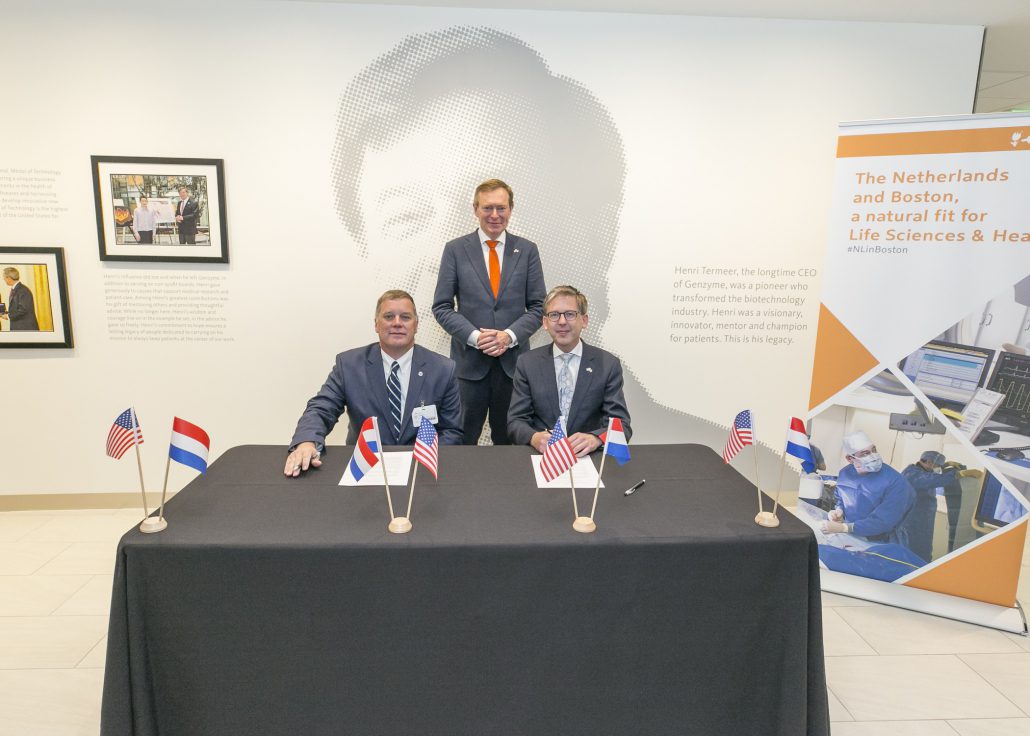
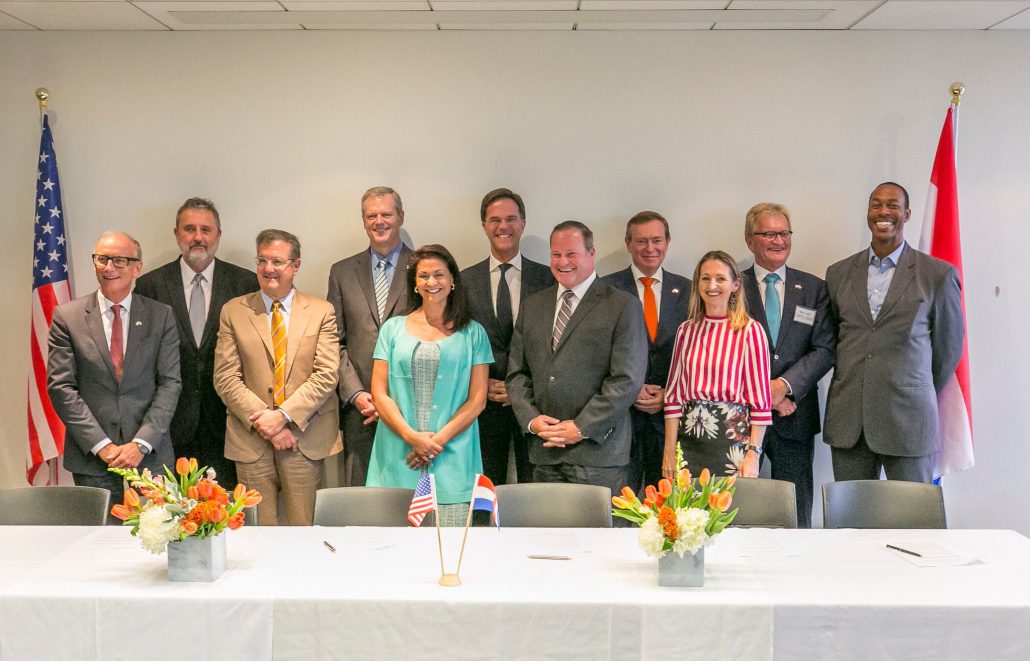
Mark Sullivan (Massachusetts Office of International Trade and Investment) and Focco Vijselaar (Dutch Ministry of Economic Affairs and Climate Policy) sign the MoU laying the basis for a Massachusetts – the Netherlands Transatlantic Life Sciences Partnership. Standing, the Dutch Minister for Medical Care Bruno Bruins. The representation of the supporting organizations of the MoU and the trade mission to Boston. From left to right: Hans Schikan (Health-Holland), Henne Schuwer (Dutch Ambassador in the United States), John Maraganore (Henri A. Termeer Tribute Committee, Alnylam Pharmaceuticals), Charlie Baker (Governor of Massachusetts), Belinda Termeer (Henri A. Termeer Tribute Committee), Mark Rutte (Prime Minister of the Netherlands), Robert Coughlin (MassBio), Bruno Bruins (Dutch Minister for Medical Care and Sport), Annemiek Verkamman (HollandBIO), Hans de Boer (VNO-NCW), Travis McCready (Massachusetts Life Sciences Center).
https://www.hollandbio.nl/wp-content/uploads/2023/08/HollandBIO_logo.svg00hollandbiohttps://www.hollandbio.nl/wp-content/uploads/2023/08/HollandBIO_logo.svghollandbio2019-07-23 16:04:242019-07-23 16:04:25Massachusetts and the Netherlands kickoff international partnership in life sciences← #nieuws
The Netherlands Centre for One Health (NCOH) was allocated a budget of two million euro Public-Private Partnership (PPP) Allowance to organise and realise their first PPP call. This call involves strategic partnerships under the Knowledge and Innovation Agenda of Top Sector Life Sciences & Health (LSH): One Health call.
The research projects should fit within the NCOH Strategic Research Agenda and one of its Solution Sets ‘Preventive Strategies’ or ‘Prophylactic Vaccines’. All NCOH partners can apply for collaborative innovation projects; though specific NCOH consortium criteria must be met.
Funding conditions
Depending on the type of research (fundamental, industrial or experimental) and the contributions by private and public partners within the project, between €250,000 and €750,000 PPP Allowance can be applied for. Submitted projects should have a total size of max. €1 million, including co-financing. An important condition is that an application must consist of a collaboration with at least one private party and an NCOH consortium of at least two contributing NCOH partners with multiple PhD students, befitting the NCOH research programme.
https://www.hollandbio.nl/wp-content/uploads/2023/08/HollandBIO_logo.svg00hollandbiohttps://www.hollandbio.nl/wp-content/uploads/2023/08/HollandBIO_logo.svghollandbio2019-07-16 16:51:112019-07-16 16:51:13One Health applications for prophylactic vaccines and preventive strategies← #nieuws
Ida Haisma is benoemd tot Directeur Leiden Bio Science Park. Zij zal leiding gaan geven aan de transformatie van het Leiden Bio Science Park van science park tot innovatiedistrict. Hiertoe zal zij een nieuwe parkorganisatie gaan opbouwen en optreden als gezicht van het park.
Ida Haisma is een ondernemende vernieuwer en verbinder met de nodige ervaring in Life Sciences & Health. Momenteel leidt ze een corporate innovatieprogramma en adviseert ze start ups in de energie‐sector. Daarvoor was zij plaatsvervangend directeur van de Vereniging Innovatieve Geneesmiddelen. Daar ontwikkelde ze strategische agenda’s voor de sector en werkte ze met bedrijven, kennisinstellingen en overheden voor de Nederlandse Life Sciences & Health‐Sector.
Ze bezit veel kennis van en ervaring met het creëren van sterke innovatieclusters. Ze was de eerste directeur van The Hague Security Delta, het Nederlandse veiligheidscluster met inmiddels meer dan 200 bedrijven, kennisinstellingen en overheden dat zij vanaf de start heeft opgebouwd. Eerder was zij ook plaatsvervangend directeur bij het Kenniscentrum Grote Steden (NICIS), waar ze de samenwerking tussen overheden, bedrijven en kennisinstellingen rond grootstedelijke ontwikkeling bevorderde.
Ida Haisma zal per 1 september a.s. haar werkzaamheden beginnen.
AM-Pharma haalt maar liefst €116 miljoen op om
de behandeling die het ontwikkelt tegen acuut nierfalen naar de kliniek te brengen.
De medische vraag naar een medicijn is groot. Jaarlijks overlijden wereldwijd
ongeveer 700.000 mensen aan acuut nierfalen, en er is nog geen behandeling
voorhanden. De financieringsronde is een van de grootste ooit van een
zelfstandig Nederlands biotech bedrijf, en kwam tot stand door een consortium
van bestaande en nieuwe investeerders. Voor AM-Pharma start hiermee een spannende
nieuwe fase, waarvoor het bedrijf flink uit zal breiden. De deal onderstreept
de potentie en innovatiekracht van de Nederlandse biotech sector, die eerder
deze week al een enorme boost kreeg dankzij de versterkte samenwerking tussen
Galapagos en Gilead.
De laatste stap die AM-Pharma moet zetten op
de lange route van lab naar registratie is bepaald geen sinecure. AM-Pharma wil
zijn kandidaat-geneesmiddel testen bij 1.400 patiënten, verspreid over honderd
ziekenhuizen in twaalf landen. De studie moet voldoende data opleveren voor
goedkeuring van het Europees Medicijn Agentschap (EMA) en de FDA in de VS.
Het succes van AM-Pharma betekent dat de
Nederlandse biotech sector weer een groeidiamant rijker is. Het bedrijf is
illustratief voor de kwaliteit en potentie van de sector, maar ook voor de
moeilijke route die een biotech bedrijf van lab naar patiënt moet bewandelen.
Vorig jaar publiceerde AM-Pharma veelbelovende resultaten van een eerdere
klinische studie in het gezaghebbende Journal of American Medical Assocation
(JAMA). Toch trok farmaceut Pfizer zich vanwege een strategische koerswijziging
terug als partner van AM-Pharma, waarna het kleine bedrijf op zoek moest naar
nieuwe financiers. De goede data, de grote medische noodzaak en de volharding
van het AM-Pharma team onder leiding van CEO Erik van den Berg maakten dit
succes mogelijk.
Het is uitzonderlijk dat een biotech bedrijf
zelfstandig deze stap richting registratie zet. Meestal wordt voor zogenaamde
fase III studies samenwerking gezocht met een grote farmaceut die de financiële
middelen en de infrastructuur heeft om deze veeleisende fase te doorlopen. Een
andere meer gebruikelijke route om kapitaal op te halen is een beursgang.
Het aantrekken van financiering is en blijft
een van de grootste uitdagingen voor start-ups en scale-ups in de biotech. Het Nederlandse
financieringslandschap vertoont fikse gaten. Een uitgekiende financieringsmix
voor biotech bedrijven in alle fases van ontwikkeling moet het huidige
marktfalen aanpakken. Invest-NL kan daar hopelijk aan bijdragen. De nationale
investeringsinstelling in oprichting heeft alles in zich om de gaten te dichten
en door te investeren in biotech start-ups en scale-ups een brug te slaan
tussen de publieke regelingen en private investeerders. Zo kan Invest-NL dienen
als vliegwiel voor innovatie en de AM-Pharma’s van morgen het broodnodige
steuntje in de rug geven.
https://www.hollandbio.nl/wp-content/uploads/2023/08/HollandBIO_logo.svg00hollandbiohttps://www.hollandbio.nl/wp-content/uploads/2023/08/HollandBIO_logo.svghollandbio2019-07-16 13:34:442019-07-19 11:03:34€116 miljoen voor AM-Pharma← #nieuws
TPI
is op zoek naar Nederlandse bedrijven die hun proefdiervrije innovaties willen
publiceren in een bidbook: een mooie kans om je bedrijf in de kijker te spelen!
TPI staat voor Transitie Proefdiervrije Innovatie. Deze transitie is gaande:
wetenschap, gezondheidszorg, beoordeling van veiligheid en acceptatie van
dierproeven veranderen. TPI staat ook voor de groep die deze ontwikkelingen wil
versnellen: RIVM, NFU, VSNU, ZonMw, Samenwerkende Gezondheidsfondsen, Stichting
Proefdiervrij en de ministeries van LNV, VWS, EZK, OCW en IenM. Het TPI-netwerk
signaleert dat er behoefte is meer te zien van wat start en scale ups allemaal
ontwikkelen zonder proefdiergebruik.
TPI nodigt
leveranciers van proefdiervrije innovaties daarom uit om zich in het TPI
bidbook te profileren. Het doel is om met zo’n bidbook overzichtelijk te laten
zien wat en waarom Nederlandse start en scale ups proefdiervrij innoveren. Het
bidbook wordt gepresenteerd tijdens de International pioneer2policymaker
conference ‘Accelerating animalfree innovations’ van 27-29 november 2019.
Wil
je dat TPI jouw bedrijfsprofiel in het bidbook opneemt? Laat het HollandBIO dan
uiterlijk 23 juli weten via info@hollandbio.nl.
Ruim 500 biotech bedrijven maakten in 2018
gebruik van de Wet Bevordering Speur- en Ontwikkelingswerk (WBSO), zo blijkt
uit het jaarverslag over deze fiscale regeling. Zij maken onderdeel uit van een
totaal van ruim 20.000 innovatieve bedrijven die dat deden, waarvan 97% midden-
en kleinbedrijf (MKB). Dit leverde hen een voordeel op van bij elkaar meer dan
€1.1 miljard.
De regeling heeft een aantoonbaar positief effect op de R&D-inspanningen en is dan ook van levensbelang voor biotech bedrijven. Afgelopen jaren nam het aantal bedrijven dat gebruik maakt van de WBSO af, vooral onder startups en MKB. RVO voert in 2019 onderzoek uit naar deze daling. HollandBIO blijft zich, in aanloop naar de begrotingsbehandeling voor 2020 in september, inspannen voor een optimale invulling van deze voor de life sciences-sector cruciale regeling.
Gilead steekt maar liefst €4,5 miljard in
de innovatiekracht van biotech parel Galapagos. De twee bedrijven maakten
zondagavond een even unieke als omvangrijke deal bekend: een win-win
samenwerking tussen de innovatiekracht van Galapagos en de wereldwijde
infrastructuur, expertise en sterke kaspositie van Gilead. De drug discovery en R&D
programma’s van Galapagos krijgen dankzij de investering een enorme boost.
Gilead bemachtigt op zijn beurt een exclusieve plek op de eerste rij om de
moleculen van Galapagos door te ontwikkelen en te verkopen buiten Europa. Een
fantastische klapper, die niet alleen een grote impact heeft op de twee
bedrijven, maar ook op de Nederlandse biotech sector als geheel.
Galapagos ontvangt een upfront betaling van
Gilead van €3,5 miljard. Daarnaast vergroot de Amerikaanse farmaceut zijn
aandeel in het Nederlands-Belgische bedrijf met €1 miljard tot 22%. De looptijd
van de samenwerking is tien jaar, wat Galapagos de tijd geeft om zijn droom te
realiseren: uitgroeien tot een onafhankelijk Europees farmaceutisch concern. Met
de deal op zak gaat Galapagos zijn R&D programma’s versnellen en
uitbreiden.
HollandBIO’s Annemiek Verkamman ziet het goede nieuws als een bevestiging van de innovatiekracht en potentie van de life sciences-sector:
“Galapagos is een fantastisch rolmodel voor de vele kleinere biotech bedrijven in Nederland en daarbuiten. Het succes van Galapagos heeft een grote magneetwerking: op financiers, op talent en alle mogelijke toeleveranciers van biotech bedrijven. Daarmee is de samenwerking niet alleen goed nieuws voor Gilead en Galapagos, maar ook voor de groei en ontwikkeling van de hele Nederlandse life sciences sector.”
De lange weg van Galapagos tot een van de
sterspelers van Europa laat eens te meer zien dat succes in de biotech een
lange adem vergt: dit jaar viert het bedrijf zijn 20ste verjaardag. Het
vinden van kapitaal is voor de groei van biotech bedrijven – naast de
wetenschappelijke complexiteit – met stip de grootste uitdaging. Het
financieringslandschap vertoont fikse gaten. Een uitgekiende financieringsmix
voor biotech bedrijven in alle fases van ontwikkeling moet het huidige marktfalen
aanpakken. Invest-Nl kan daar hopelijk aan bijdragen. De nationale
investeringsinstelling in oprichting heeft alles in zich om de gaten te dichten
en door te investeren in biotech start-ups en scale-ups een brug te slaan
tussen de publieke regelingen en private investeerders. Zo kan Invest-NL dienen
als vliegwiel voor innovatie. Het succes van Galapagos laat zien waar het
investeren in innovatieve biotech start-ups en scale-ups toe kan leiden. Daar
kan Nederland er nog wel een paar van gebruiken, toch?
Lees meer
De fantastische samenwerking tussen Galapagos
en Gilead krijgt – terecht – volop aandacht in de media. Een greep uit de
berichtgeving:
Ncardia expands its iPSC manufacturing site in Belgium, R&D and drug discovery center in the Netherlands, and commercial operations in the USA. The accelerated investment followed the retraction of the Cor.4U product line from the market and resulting insolvency of its former legal entity in Germany(operating under the name Ncardia AG / former Axiogenesis).
Ncardia shared today that all active investors participated in a capital increase, signaling confidence in its expanded offerings in iPSC drug screening services, contract cell manufacturing and iPSC-based cardiovascular and neurological cell models. Under the restructuring following the closing of Ncardia AG operations in Germany, all manufacturing services have been concentrated at its ISO 9001-certified contract and product manufacturing facility in Gosselies, Belgium and activities in drug discovery / safety services continue to operate from its Leiden, Netherlands headquarters.
“We continue our dedication to the advancement of iPSC technologies in the drug discovery space and are excited that with the support of our investors, we can continue providing quality iPSC-derived products and accelerate our capabilities in contract cell manufacturing and drug discovery assay development,” said Stefan Braam, CEO of Ncardia.