← #nieuws

Manifest Campusontwikkeling

Op maandag 28 september heeft Staatssecretaris Mona Keijzer van Economische Zaken positief gereageerd op de oproep van de 10 grootste scienceparken en innovatie campussen van Nederland om juist ook te investeren in het fysieke aspect van innovatie: toplocaties waar onderzoek en bedrijven elkaar letterlijk ontmoeten. Zij beaamde dat juist in deze tijden van thuiswerken is gebleken hoe belangrijk ontmoetingen zijn voor innovatie. Ook complimenteerde ze de 10 toplocaties voor het feit dat zij de handen in één hebben geslagen. Ze begreep de wens om meer samenhang in het beleid en de investeringen in campusontwikkeling en gaf aan dat die oproep voor ‘een strik’ op het juiste moment komt. Zij moedigde de campussen aan samen met haar ministerie en het ministerie van OCW in gesprek te gaan over een mogelijke aanvraag voor het Groeifonds.

De 10 campusorganisaties sloegen eerder dit jaar de handen in één en stelden het Manifest Toplocaties op, waarin zij het kabinet oproepen campusontwikkeling tot rijksbeleid te maken en te investeren in de verdere ontwikkeling van deze toplocaties. Nu worden de campussen vaak regionaal gefinancierd en blijken juist de zaken die van grote meerwaarde zijn voor het creëren van ontmoeting en innovatie, zoals gedeelde faciliteiten en business developers lastig te financieren. Ook de bereikbaarheid van de campussen en het parkeren is vaak een probleem.

Daar staat tegenover dat de campussen zeer belangrijk zijn voor het potentiele verdienvermogen van Nederland. Vaak wordt kennis uit de universiteiten op deze campussen daadwerkelijk omgezet in nieuwe producten en bedrijven. De werkgelegenheidsgroei op de campussen ligt met 22% tussen 2014 en eind 2018 dan ook fors boven het landelijke gemiddelde. De campussen zijn een bewezen ‘banenmotor’.

De campusorganisaties spelen een faciliterende rol op de achtergrond. De toevallige ontmoeting en het bouwen van ecosystemen lijkt iets vanzelfsprekends en bijna een automatisme, maar vraagt gerichte aandacht en inspanning van de campusorganisaties. Ook deze inspanningen dienen gefinancierd te worden.

Staatssecretaris Mona Keijzer was op bezoek bij één van de 10 toplocaties: Kennispark Twente. Met ruim 400 bedrijven en gestart in 1980 de grootste en oudste campus van de tien. Maar ook degene met grote uitdagingen om het Kennispark aantrekkelijk te maken voor de vestiging van nieuwe bedrijven en het vasthouden van talent. “We hebben last van de wet van de remmende voorsprong”, stelt gebiedsdirecteur Anne-Wil Lucas. “Er liggen grote opgaven om van Kennispark een innovatiecampus te maken die voldoet aan de eisen van deze tijd. Waar wonen, werken en recreëren gecombineerd wordt en waar ontmoeting en verbinding tussen bedrijven, studenten en onderzoekers centraal staat. Kennispark is niet alleen van belang voor de UT en de gemeente Enschede, maar voor heel Twente en heel Nederland. Hier komen bijvoorbeeld oplossingen vandaan die de gezondheidszorg betaalbaar helpen houden en worden materialen en machines ontwikkelt die duurzaam vervoer binnen handbereik brengen. Het is daarom goed dat gezamenlijk geïnvesteerd wordt in de toekomst van onze campus.”

De 10 toplocaties zijn: Amsterdam Science Park, Brightlands Chemelot Campus, Campus Groningen, High Tech Campus Eindhoven, Kennispark Twente, Leiden BioScience Park, TU Delft Campus, TU Eindhoven, Utrecht Science Park en Wageningen Campus.

Het volledige manifest is te lezen op www.topcampussen.nl

Bron: Kennispark (Persbericht)
← #nieuws

Maatschappelijk investeringsfonds INZET investeert €2 miljoen in iClusion

Maatschappelijk investeringsfonds INZET investeert in iClusion, een jonge onderneming die een innovatief internet platform aanbiedt om patiëntgebonden onderzoek naar nieuwe medicijnen beter toegankelijk te maken en te versnellen. De gezamenlijke investering van €2 miljoen door INZET en de huidige aandeelhouders stelt iClusion in staat om meer ziekenhuizen toegang te geven tot het internetplatform, meer studies met nieuwe medicijnen beschikbaar te maken, en te starten met de internationale uitbreiding van het platform.  

iClusion is opgericht vanuit het inzicht dat ernstig zieke patiënten nog te vaak buitenspel staan om aan onderzoek naar nieuwe behandelingen deel te kunnen nemen. Als eerste heeft iClusion, met de patiënt als vertrekpunt in het proces, een online platform ontwikkeld dat medicijnstudies naar de patiënt en arts toe brengt, in plaats van andersom. De patiënt en behandelend arts kunnen nu samen eenvoudig en snel geschikt onderzoek vinden en hieraan deelnemen. In eerste instantie richt iClusion zich op kankeronderzoek met de mogelijkheid om snel uit te breiden naar andere ernstige ziekten.  

Pieter Oostlander, founding partner INZET: “Wij zijn trots op de samenwerking met iClusion. Hun platform levert directe toegevoegde waarde voor patiënten, artsen en onderzoekers. Het past dan ook uitstekend bij de doelstellingen van ons maatschappelijk investeringsfonds.” 

Deelname aan onderzoek naar nieuwe behandelingen is niet eenvoudig vanwege de strenge wet- en regelgeving waaraan onderzoek met patiënten noodzakelijkerwijs gebonden is. Het Trial Eye platform vermindert de bureaucratie en vergroot de efficiëntie van patiëntgebonden onderzoek door gestandaardiseerde en geautomatiseerde processen. Dit stelt artsen en onderzoekers in staat om sneller studies te kunnen opstarten in hun ziekenhuis en meer patiënten te kunnen laten deelnemen. Deze procesverandering versnelt het ontwikkelingsproces van nieuwe geneesmiddelen en dat komt patiënten van vandaag en morgen ten goede. Deelname aan onderzoek vandaag versnelt de goedkeuring en toegankelijkheid van nieuwe medicijnen in de toekomst.    

KWF, deelnemend fonds van INZET – directeur Johan van de Gronden: “Ik ben blij met deze investering. Op deze manier kunnen meer patiënten makkelijker deelnemen aan klinische studies. Dit is zeer belangrijk in de strijd tegen kanker. Met INZET kunnen we nu op een verantwoorde wijze een commerciële ontwikkeling steunen die in het belang is van patiënten.” 

Bianca Schoonbeek, adjunct directeur van de Maag Lever Darm Stichting, deelnemend fonds van INZET: “Doordat MLD-patiënten dankzij iClusion snel en eenvoudig een beter beeld kunnen krijgen van extra behandelingsopties, ervaren zij meer grip op het ziekteproces. Dat juichen wij enorm toe”.  

Met deze investering  zal iClusion de positie  van  patiënten in onderzoek naar nieuwe behandelingen verder versterken. Binnenkort zal iClusion ook een publiek platform beschikbaar stellen waar patiënten met kanker en hun naasten direct toegang krijgen tot hetzelfde overzicht van lopend onderzoek als hun artsen. Door patiënten in begrijpelijke taal zelf toegang te geven tot extra behandelingsmogelijkheden kunnen zij zich goed voorbereiden op een gesprek met hun arts met als doel om meer patiënten aan onderzoek te kunnen laten deelnemen. 

Edwin Klumper, oprichter en voorzitter van de  board van iClusion: “INZET is de juiste investeerder op het juiste moment voor iClusion. INZET levert toegevoegde waarde door ruime ervaring in maatschappelijk ondernemen. Samen streven we naar een betere behandeling van kanker en andere ernstige ziekten door patiënten en artsen te helpen gemakkelijker aan onderzoek met nieuwe behandelingen te kunnen deelnemen.  Immers, onderzoek vandaag is de behandeling van morgen.” 

Bron: Persbericht

← #nieuws

CATO SMS Acquires Array Biostatistics

CATO SMS announced that it has acquired Wilmington, NC-based Array Biostatistics (Array) to expand its offering of specialized clinical research solutions.  The company plans to invest in growing Array and its highly regarded biostatistical capabilities.

Both Array and CATO SMS offer highly specialized services that expedite and support drug development for small and emerging biopharmaceutical companies.  By acquiring Array, CATO SMS adds expertise and scale to its full-service biostatistical consulting, analysis and programming capabilities.  CATO SMS will focus on growing these capabilities and its team of senior biostaticians and statistical programmers, as it continues to expand its product development consulting and clinical trial operations.  Sandy Ferber, chief executive officer of Array, will continue to lead Array and will spearhead CATO SMS’ overall biometrics offering.

“We are thrilled to have this opportunity to grow our biostatistical offering in partnership with CATO SMS.  Together, we share core values centered around high quality and a commitment to providing our clients with expert and highly personalized service.  We have already identified a number of areas where, as a result of our combination, we will be able to provide our clients with enhanced capabilities in the future,” said Ms. Ferber.

Mark A. Goldberg, M.D., executive chairman, CATO SMS, added, “We are excited to welcome Array’s impressive team to CATO SMS.  They are differentiated by their consultative approach, wealth of industry experience and commitment to client satisfaction.  The Array acquisition furthers our goal of providing our clients with a comprehensive portfolio of specialized solutions to best support development in complex therapeutic areas including oncology, rare and orphan indications, and cell and gene therapy, among others.”

CATO SMS’ acquisition of Array marks another advancement in the company’s strategic expansion.  The company was formed in 2019 when Cato Research merged with SMS-oncology.  Working together with healthcare investors, Water Street Healthcare Partners and JLL Partners, CATO SMS has extended its global footprint, deepened its oncology and regulatory expertise, and bolstered its suite of solutions. With offices across North America, Europe, and the Middle East, CATO SMS conducts trials in more than 20 countries.  To date, the company has contributed to the successful development of more than 50 marketed products.

Source: CATO SMS

← #nieuws

Roche looks to genetic modifiers for new drug targets, teaming up with Scenic Biotech in $375M deal

Roche is gambling on a new way of discovering drug targets and, ultimately, promising to infuse more than $375 million into a small biotech if all goes well. A spinout of the Netherlands Cancer Institute and Oxford University, Scenic Biotech set out to pioneer a field that’s gaining some traction among top VCs in the US: to harness the natural protecting powers of genetic modifiers — specific genes that suppress a disease phenotype.

After each getting a PhD from the prestigious Dutch research center and spending time in the Boston/Cambridge biotech hub, Thijn Brummelkamp and Sebastian Nijman built their functional genomics platform and named it Cell-Seq. The tech allows scientists to sift through all 20,000 genes in haploid cells (which have only one set of chromosomes), identify the genes that modify a given disease, and create a library of maps pinpointing them.

“There have been other modifiers discovered but these have mostly been discovered by serendipity,” Nijman, who’s also the CSO, told Endpoints News. “What we are now doing is doing this systematically.”

Oscar Izeboud, a former banker who was recruited to be CEO this July, put it this way: “It’s a very fast way to find a needle in a haystack.”

Once they find it, the strategy is to then find gene products — proteins — that can be targeted with small molecule drugs or antibodies. In most cases they would be enzymes, such as QPCTL, which Scenic believes is a druggable modifier of the CD47 checkpoint.

The other internal efforts have mainly focused on rare inherited metabolic disorders, where Nijman and Izeboud believe the 20-people-and-growing team can handle the clinical work.

Their new partners at Genentech are interested in an area that Scenic has not gone into. In addition to the undisclosed upfront, the deal covers target selection fees as well as milestones and royalties.

Scenic, though, isn’t the only startup claiming to have the necessary tools to unpack genetic modifiers — an idea that’s central to the mystifying notion that people born into the same family, with the same genes, don’t always have the same disease.

San Francisco-based Maze Therapeutics launched last year with $191 million from a syndicate led by ARCH and Third Rock, boasting a similar genetics platform designed to unearth new targets. Nessan Birmingham’s Triplet Therapeutics, meanwhile, is focused on the DNA level, leveraging antisense oligonucleotides to hit the DNA damage response pathway.

In comparison Scenic’s beginning was much more humble, raising €6.5 million from European firms BioGeneration Ventures and INKEF Capital, with some support from the university-affiliated Oxford Sciences Innovation and later the Dutch government.

But it’s not stopping Nijman from dreaming big.

Aside from the big Roche collaboration, he also has in his corner seasoned drug such as GSK vet Chas Bountra and cell therapy expert Ton Schumacher, who’s just embarked on his own new venture with Arie Belldegrun and David Chang. If anything, the buzz that rivals are generating is welcome.

“People are starting to realize and wake up to the fact that this is now possible,” Nijman said. “We can now go after this type of drug target.”

Source: EndpointsNews

← #nieuws

HollandBIO proud partner of new research on Diversity & Inclusion in the Dutch startup ecosystem

HollandBIO is proud to be a partner for the newest research of the Dutch Startup Association (DSA) on Diversity & Inclusion in the Dutch startup ecosystem. With the rise of recent events regarding for example the systematic racism against people of colour, it is crucial to shed light on these issues and work towards a more inclusive and diverse society. By acknowledging these values on a startup level, we can strive for a(n) (work)environment in which all people are respected for who they are and achieve their full potential. For this research, the DSA is still looking for participants in this survey. If you are an employee in a Dutch startup or scaleup who would like to participate in this research, please fill in the following survey here.  

← #nieuws

LAVA Therapeutics Announces $83 million Series C Financing to Advance Novel Immuno-Oncology Programs

LAVA Therapeutics, a biotech company pioneering the development of bispecific antibodies to engage gamma-delta T cells for cancer therapies, today announced the closing of an oversubscribed $83 million (€71 million) Series C financing to fund the advancement of its pipeline and platform. The financing was co-led by new investors Novo Ventures, the venture arm of Novo Holdings, and Sanofi Ventures, and included additional new investors Redmile Group, LLC, Ysios Capital and BB Pureos Bioventures. In addition, current investors Versant, Gilde Healthcare and MRL Ventures Fund, LLC participated significantly in the round.

As part of the transaction, Nanna Lüneborg, partner at Novo Ventures, Laia Crespo, EU head of investments at Sanofi Ventures, and Joël Jean-Mairet, managing partner and co-founder of Ysios, joined LAVA as members of the board of directors.

“We are grateful to have attracted a high-quality syndicate of new investors complementing strong continued support of our existing investors. This financing provides meaningful capital to advance our bispecific gamma-delta T cell engager portfolio into multiple proof-of-concept clinical trials expected to start in 2021 for the treatment of solid tumors and hematologic malignancies,” said Stephen Hurly, chief executive officer of LAVA Therapeutics. “We believe our targeted approach, leveraging the unique features of gamma9-delta2 T cells with innovative bispecific antibodies, will deliver novel T cell-based therapies offering advantages over today’s oncology treatments. In addition to the funding raised, the appointments of Nanna, Laia and Joël to our board further strengthen our team, and we look forward to benefiting from their insights and industry expertise.”

Gamma-delta T cells are the natural surveillance cells of the immune system, continuously patrolling the human body for the identification and targeting of tumor cells. These cells bridge the innate with the adaptive immune system and are a largely untapped opportunity in cancer treatment. LAVA’s bispecific gamma-delta T cell engager platform is harnessing the unique properties of these T cells creating a revolutionary truly tumor-targeted immunotherapy to improve outcomes for cancer patients.

“LAVA’s bispecific antibody approach to targeting and engaging gamma-delta T cells has the potential to transform the treatment of a wide range of cancers,” said Dr. Lüneborg. “We are impressed by the preclinical data generated by LAVA to date, which validate the company’s platform and support their transition into a clinical-stage organization. The team is highly experienced in drug development, and I look forward to working with them.”

“Gamma-delta T cells are an emerging field and an incredibly exciting area in oncology. Bispecific antibodies able to directly engage this type of cells offer the potential to significantly impact patients across the globe in these diseases with high morbidity and mortality,” said Dr. Crespo

Source: Lava Therapeutics (Press release)

← #nieuws

MSD en Janssen versterken Nederlandse life sciences-ecosysteem

,

Door de groeiende vraag naar onder meer onderzoek en ontwikkeling van vaccins, breiden MSD en Janssen hun productiefaciliteiten in Nederland uit. Samen zijn zij op zoek naar ruim 450 nieuwe medewerkers.

MSD zoekt momenteel 200 nieuwe collega’s voor hun productie- en verpakkingsfaciliteit in Boxmeer, die met allerlei bijzondere technologieën en clean rooms zeer hightech is. Dat wordt alleen maar beter met de nieuwe vriesdroogfabriek die eind dit jaar in gebruik wordt genomen. Ook op de andere MSD-locaties in Haarlem en Oss wordt op dit moment volop gebouwd.

Janssen werkt aan een kandidaat-vaccin tegen het coronavirus en voert momenteel vroege klinische studies uit om het veiligheidsprofiel en de immuunrespons te onderzoeken. Tegelijkertijd start Janssen alvast de productiefaciliteit van het kandidaat-vaccin op. Om alle werkzaamheden te realiseren, zijn er 250 nieuwe medewerkers nodig.

Beide farmaceutische bedrijven zorgen voor een versterking van het Nederlandse life sciences-ecosysteem. Ze breiden hun productiefaciliteiten uit om vaccins in Nederland te (blijven) produceren en leveren daarbij ook nog eens significante werkgelegenheid. Niet alleen waardevol voor de wereld, maar ook  voor de Nederlandse economie.

Lees verder:

← #nieuws

Neogene Therapeutics Raises $110 Million Series A Financing to Develop Next-Generation Fully Personalized Neo-Antigen T Cell Receptor (TCR) Therapies

Neogene Therapeutics, Inc., a pre-clinical stage biotechnology company pioneering a new class of fully personalized neo-antigen T cell therapies to treat cancer, today announced that is has raised $110 million in a Series A financing. The financing was co-led by EcoR1 Capital, Jeito Capital and Syncona, with participation from Polaris Partners and Pontifax. Seed investors Vida Ventures, TPG and Two River also participated in the round.

Neogene, a Two River company, was founded in 2018 by a team of world-class cell therapy experts to advance the development of neo-antigen T cell therapies. Carsten Linnemann, Ph.D., Chief Executive Officer of Neogene, and Ton Schumacher, Ph.D., Principal Investigator at the Netherlands Cancer Institute, Oncode Institute and 2020 recipient of the Dutch Research Council’s Stevin Award co-founded the company with individual investments by cell therapy industry veterans Arie Belldegrun, M.D. FACS, founder of Kite Pharma, Inc. and Co-Founder and Executive Chairman of Allogene Therapeutics, Inc. and David Chang, M.D., Ph.D., Co-Founder, President and Chief Executive Officer of Allogene. Dr. Linnemann and Dr. Schumacher previously co-founded T-Cell Factory B.V., a company acquired by Kite Pharma in 2015.

Dr. Schumacher, an internationally leading immunologist in the areas of neo-antigen biology and T cell engineering, developed the seminal concepts of Neogene’s proprietary technology. Neogene’s platform allows for the isolation of neo-antigen specific TCR genes from tumor biopsies that are routinely obtained from cancer patients during treatment. The tumor-infiltrating lymphocytes (TIL) obtained by these tumor biopsies frequently express TCRs specific for mutated proteins found in cancer cells (neo-antigens). The Company’s proprietary technology uses state-of-the-art DNA sequencing, DNA synthesis and genetic screening tools to identify such neo-antigen specific T cell receptor genes within tumor biopsies with high sensitivity, specificity and at scale. The isolated TCR genes are subsequently engineered into T cells of cancer patients to provide large numbers of potent T cells for therapy.

“Neogene is committed to forging a path for new fully personalized engineered T cell therapies in solid cancer that are redirected towards neo-antigens found on cancer cells,” said Dr. Linnemann. “While engineered T cell therapies have transformed the treatment paradigm for patients with hematologic malignancies, the industry has struggled to translate this success to the enormous unmet need in patients with advanced solid tumors. We believe that through a fully individualized approach using patient-specific TCRs to target neo-antigens, engineered T cell therapy can become broadly accessible to these patients. We are excited that our vision is shared by an outstanding syndicate of marquee investors, who have a deep understanding of and commitment towards the development of novel cell therapies in oncology.”

“Neo-antigens represent ideal targets for cancer therapy, as they inevitably arise from DNA mutations that enable tumor development in the first place. Further supporting this concept is clear, correlative evidence linking T cell reactivity against neo-antigens with tumor regression in several patients.” said Dr. Schumacher. “The Neogene platform makes it possible to exploit the neo-antigen reactive TCRs that are present in TIL without a requirement for viable tumor material. In addition, its syn-bio based approach offers major advantages with respect to standardization and scalability and will be critical to achieve our goal of bringing personalized engineered T cell therapies to patients.”

In this Series A financing, Neogene expands its distinguished investor base with leading health-care investors from both the US and Europe. For the seed-investors Vida Ventures, TPG and Two River, Neogene marks the second major collaboration in the cell therapy space after the launch of Allogene Therapeutics in 2018. Neogene’s seed-financing in 2019 enabled the Company to achieve proof-of-concept for its neo-antigen technology platform and built on the respective expertise of Vida Ventures, Two River and TPG in the gene and cell therapy space.  

“We believe that Neogene’s technology and therapeutic approach has the potential to become a game changer for the treatment of cancer,” said Oleg Nodelman, Founder and Managing Director of EcoR1 Capital. “We are impressed by the bold vision of the management team and are thrilled to support Neogene as it advances its mission of developing novel therapies for cancer patients in need.”

“Neogene’s approach perfectly aligns with Jeito’s mission. Jeito was launched recently to support new and established entrepreneurs aspiring to help patients in need by pioneering novel, ground-breaking medicines underlined by highest quality innovation,” said Rafaèle Tordjman, Founder and Chief Executive Officer at Jeito Capital. “We are delighted to welcome Neogene as the first investment into our new portfolio.”

“We are excited to partner with the outstanding Neogene team,” said Martin Murphy, Chief Executive Officer of Syncona. “Neogene’s technology offers a radically innovative approach to utilize the therapeutic potential of TIL cells by employing state-of-the-art TCR engineering and synthetic biology technologies.” Facilitated by the Series A, Neogene intends to further develop its technology with growing offices in Amsterdam and the US with the goal to initiate Phase I clinical studies in 2022.

Source: Neogene Therapeutics (Press release)

← #nieuws

Quality by Design en TRIUM bundelen krachten

Quality by Design (QbD), de referentie binnen consultancy voor de life sciences-sector, en clinical solutions provider TRIUM Clinical Consulting (TRIUM) bundelen hun krachten. Dit samengaan van beide consultancybedrijven creëert zo een unieke, complementaire service offering voor de volledige life cycle van een product of therapie. Zowel voor QbD als TRIUM is het een nieuwe grote stap in hun verdere  groei en betekent het tevens een logische vervollediging van hun services.

Wanneer een nieuwe therapie of technologie bedacht wordt, volgt er een uitgebreid product life cycle-traject alvorens het op de markt kan en mag komen. Door samen te gaan bieden QbD en TRIUM de life sciences-spelers voortaan een end-to-end offering doorheen de hele product life cycle: van het opzetten van kwaliteitssystemen over ISO-certificeringen tot de volledige ‘from idea to patient’-levensweg.

QbD kent al sinds zijn oprichting in 2011 een heel sterke groei en stelt vandaag wereldwijd 200 mensen te werk, waarvan 142 in België. Het verbreedde en verdiepte gaandeweg zijn speelveld, ook op het vlak van twee specifieke speerpunten: medical devices en ATMP’s. Onder die eerste term vallen alle mogelijke medische hulpmiddelen, van eenvoudige zaken zoals spuiten en smart watches tot enorm complexe instrumenten zoals neurostimulatoren en stents. “Vooral voor die laatste categorie is het verzekeren van de kwaliteit, veiligheid en effectiviteit een extreem ingewikkelde opdracht waar zowel wij als TRIUM ons al jaren in specialiseren”, zegt Bart van Acker, oprichter en CEO van QbD. “Volgens de Europese wetgeving moet elk medical device bovendien ook klinisch getest worden. Door de aanwezigheid van TRIUM binnen de QbD Group, kunnen klanten nu dat volledige traject bij ons neerleggen. En ook op het vlak van ATMP’s – dat zijn geneesmiddelen voor geavanceerde therapie, zoals celtherapie en gentherapie – zien we in TRIUM de ideale klinische partner.”

QbD en TRIUM werken al jaren samen op een aantal klantprojecten. “We weten dus al wat we aan mekaar hebben en zijn heel blij dat we door deze stap nog nauwer en beter gaan samenwerken”, vult Christof Debèfve, mede-oprichter en verantwoordelijk voor business development bij TRIUM, aan. “Los van de enorme complementariteit van onze diensten – waardoor we nu samen een unieke plek in de life sciences-consultancy innemen – is QbD met zijn doe-mentaliteit en hoge fun-factor ook qua bedrijfsDNA de ideale match voor ons.”

Ondanks dat Quality By Design meerderheidsaandeelhouder wordt binnen TRIUM, behoudt die laatste maximale zelfstandigheid en verandert er voor de medewerkers niets. Het TRIUM-kantoor in Lier bijvoorbeeld blijft gewoon bestaan. “Dit partnership draait echt om een win-win voor beide partijen én voor de sector, waarbij onze eigen bedrijfsfilosofie intact blijft”, benadrukt Debèfve. “Bovendien biedt het samengaan met QbD – al een tijd dé Belgische en stilaan ook de internationale referentie in hun vak – ook veel specialisatie- en doorgroei-opportuniteiten voor ons wereldwijde team van een honderdtal werknemers en consultants.”

“Ook ik ben heel blij met deze stap”, zegt Van Acker. “Los van onze historie samen, is TRIUM ook een heel bekende speler in hun niche. Ze waren al heel gestaag aan het groeien en dankzij de synergieën die we nu creëren, onder andere via het internationale QbD-kantorennetwerk, gaan we nu samen van zowel QbD als TRIUM een nóg sterker groeiverhaal maken.”

Bron: QbD (Persbericht)

← #nieuws

Ministers Wopke Hoekstra en Eric Wiebes lanceren Nationaal Groeifonds

,

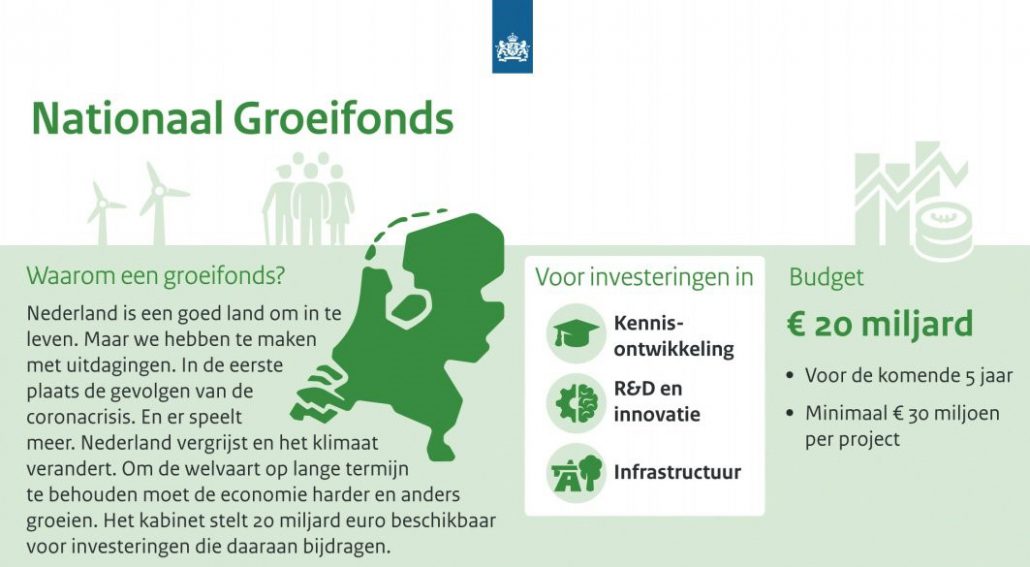
Vandaag hebben ministers Wopke Hoekstra en Eric Wiebes het Nationaal Groeifonds (ook wel het Wopke-Wiebesfonds genoemd) gelanceerd. In aanloop naar Prinsjesdag wordt steeds meer bekend over hoe dit fonds eruit gaat zien, wat de procedure is die mogelijke projecten moeten doorlopen en aan welke criteria zij moeten voldoen. Investeringen in sleuteltechnologieën, waar biotechnologie en life sciences ook onder vallen, en de ecosystemen daaromheen staan centraal in het R&D- en innovatie-onderdeel van het Groeifonds.

Groeifonds krijgt verder vorm
In plaats van in één keer het benodigde grote bedrag op te halen, stelt het kabinet voor om jaarlijks €4 miljard te lenen. Eerder werd al bekendgemaakt dat de investeringen uit het fonds een incidentele impuls moeten vormen en niet structureel van aard zijn. Daarbij moet de investering aantoonbaar blijvend bijdragen aan het vergroten van het Nederlandse innovatie- en verdienvermogen.

Beoordeling onafhankelijke commissie
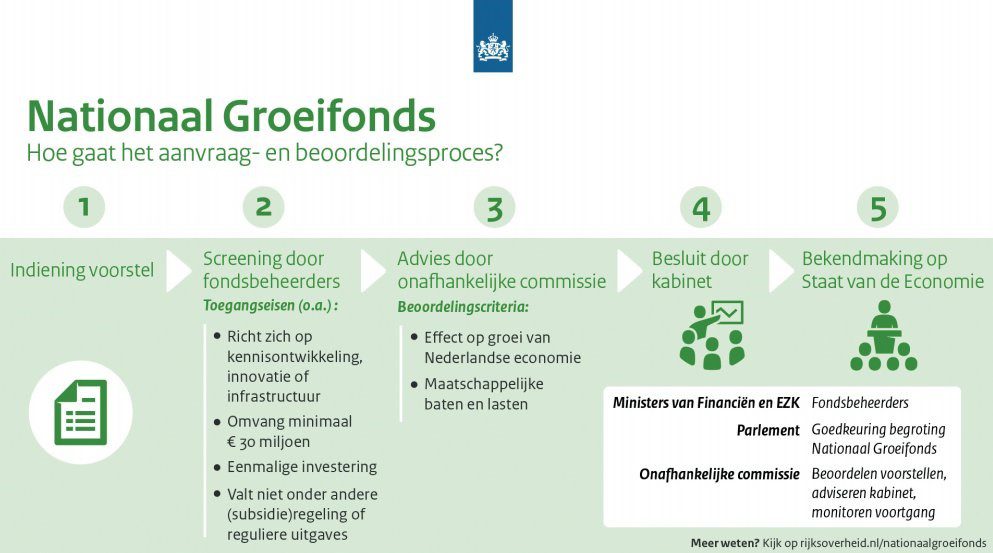
Zoveel mensen, zoveel wensen: het Groeifonds is een erg populaire regeling en nu al overvraagd. Na indiening van een voorstel zullen fondsbeheerders beoordelen of het voorstel voldoet aan de voorwaarden van het fonds. Daarna wordt de aanvraag door een onafhankelijke commissie beoordeeld op het effect op het verdienvermogen en in hoeverre het bijdraagt aan maatschappelijke doelen. In deze commissie zetelen onder meer voormalig DSM-topman Feike Sijbesma, ASML-ceo Peter Wennink en wetenschapper Robbert Dijkgraaf. Het kabinet besluit uiteindelijk over de toekenning van middelen uit het fonds.

Vervolgstappen
De Tweede Kamer moet het fonds nog goedkeuren en zal zich erover uitlaten tijdens de begrotingsbehandeling van het ministerie van EZK. Daarbij heeft het kabinet ook aangegeven alvast een start te willen maken met enkele projecten. Op korte termijn zullen dus al de eerste projecten bekendgemaakt worden.

Afbeelding
Afbeelding