← #nieuws

Geeft blanco cheque Europese biotech meer SPACe?

Life Sciences Partners (LSP) heeft vorige week aangekondigd dat zij de eerste Europese Biotech Special Purpose Acquisition Company (SPAC) naar beursgang aan de NASDAQ hebben gebracht. De SPAC, genaamd European Biotech Acquisition Corporation (EBAC), haalde $120 miljoen op en zal worden aangestuurd door ervaren biotech ondernemer Eduardo Bravo. HollandBIO geeft graag wat meer duiding bij een SPAC.

Wat is een SPAC?

SPAC staat voor Special Purpose Acquisition Company. Een SPAC is een blancochequebedrijf; een omhulsel dat in eerste instantie als een beleggingsconstructie wordt gebruikt. In de eerste fase wordt er financiering opgehaald middels een beursgang. In de tweede fase gaat de SPAC op zoek naar een niet-beursgenoteerd bedrijf dat wil fuseren.

Lukt dat binnen de afgesproken tijd? Dan krijgen de aandeelhouders een belang in het bedrijf. Het bedrijf zelf krijgt dan een beursnotering. Lukt dat niet? Dan wordt de zoektocht stopgezet. Het geld vloeit terug naar de beleggers en de SPAC wordt opgeheven.

Nieuwe financieringstrend

SPACs bestaan al een langere tijd in de Verenigde Staten en zijn nu komen overwaaien naar Europa. De constructie wordt veel gebruikt voor snelgroeiende bedrijven die sneller en efficiënter een beursgang willen realiseren en een flinke financieringsronde willen ophalen als vliegwiel voor hun innovaties.

SPACs verlagen de drempel voor toetreding tot de markt en het ophalen van kapitaal, maar kunnen ook zorgen voor een te vroege beursgang. HollandBIO is dan ook benieuwd of deze financieringstrend in Europa zijn waarde gaat bewijzen. 

Lees verder:
← #nieuws

RiboPro haalt € 1,2 miljoen op voor doorontwikkeling hoogwaardige RNA-producten

Biotech start-up RiboPro uit Oss heeft € 1,2 miljoen groeigeld opgehaald. De nieuwe financiering wordt gebruikt om de gepatenteerde messenger RNA-technologie van RiboPro verder te ontwikkelen, het team te versterken en het bedrijf op te schalen. Een consortium van de Brabantse Ontwikkelings Maatschappij (BOM), Rockstart en verschillende particuliere investeerders onder leiding van Stichting Vlasroot heeft aan de financieringsronde bijgedragen. RiboPro ondersteunt met haar RNA-producten onderzoekers en farmaceutische bedrijven bij de ontwikkeling van nieuwe medische behandelingen. Verschillende covid-19 vaccins zijn gebaseerd op de messenger RNA-technologie.

“We zijn blij dat we zo’n sterk consortium van investeerders aan boord hebben”, zegt Sander van Asbeck, CEO en oprichter van RiboPro (foto midden). Messenger RNA speel een cruciale rol in een medische revolutie die net is begonnen en voor heel veel mensen van grote betekenis is. Met deze nieuwe investeerders aan boord voelen we ons meer dan ooit klaar om in die revolutie een belangrijke rol te spelen.”

Roel Elshout van Vlasroot: “Het is een voorrecht dat we RiboPro kunnen helpen om een toonaangevende speler te worden in de wereld van mRNA-producten. De huidige COVID-19 messenger RNA-vaccins hebben het potentieel van de technologie aangetoond. Wij zijn ervan overtuigd dat mRNA de industrie voor altijd zal veranderen.”

“RiboPro tilt mRNA naar een hoger niveau, verhoogt de activiteit van mRNA en verlaagt de toxiciteit en immunogene respon”, zegt Mercedes Tuin, Senior Investment Manager bij de BOM. “Potentiële toepassingen van RiboPro’s mRNA zijn talrijk, zowel in onderzoek, tissue engineering als in therapeutica. We zijn er trots op dat we deel uit maken van deze reis en kijken ernaar uit om met het team samen te werken om van RiboPro een wereldwijde leverancier van mRNA van topkwaliteit te maken.”

Volgens Tonko Wedda, directeur van Rockstart Health toont het succes van de COVID-19-mRNA-vaccins het toekomstige potentieel van mRNA. ”Steeds meer onderzoekers en farmaceuten zullen interesse zijn geïnteresseerd in de techniek. RiboPro is heel goed voorgesorteerd om hierop in te spelen.“

Bron: BOM (Nieuwsbericht)

← #nieuws

Annogen and KeyGene to collaborate in research on non-coding DNA influencing gene expression

Annogen, the Amsterdam based biotech company behind the SuRE™ technology for the functional annotation of the non-coding part of the genome, and KeyGene, the Wageningen based research company developing innovative technologies for crop improvement, are to collaborate in identifying non-coding DNA fragments in plants’ genomes that influence the expression of important crop traits. This will open new possibilities to intentionally upregulate or downregulate the expression of important genes in crops.

Plant traits are encoded by genes. Genes are accompanied by a promotor, the DNA that generally controls where and to what extent genes are expressed. Genes important for flowering are thus active in flowers, whereas genes coding for resistance against leaf-killing fungi are mainly active in leaves.

The part of plants’ genomes that do not harbor genes is often referred to as the ‘non-coding DNA’. Promoters are an example of such non-coding DNA, but research shows that beyond promoters small non-coding regions occur that may also strongly influence the expression of genes. Nevertheless, research into gene expression in plants till now mainly focused on promotors and genes.

Scientists at KeyGene develop new technologies for plant breeding. That is why they are very much interested in the possibilities non-coding DNA technologies can offer to improve plant breeding. Joris van Arensbergen, founder and CEO, is very enthusiastic about the new collaboration. “KeyGene is well known for its contributions to innovate plant breeding. While Annogen has its primary focus on medical applications like cell therapy and drug discovery, it has already established the applicability of its SuRE™ technology in animals and plants. We are very excited to now further demonstrate how our SuRE™ can contribute to crop improvement through this collaboration.” said Van Arensbergen.

At KeyGene, having strong expertise and track record in plant genomics, from unique DNA isolation protocols to powerful data visualization and management tools, studying non-coding DNA is seen as a promising next level. “Employing knowledge about non-coding DNA and about available and induced genetic variation in this part of plants’ DNA, may well lead to breakthrough technologies for crop improvement” said Arjen van Tunen, co-CEO of KeyGene.

Source: KeyGene (Press release)

← #nieuws

Organ-on-chip project receives € 4.8 million grant for revolutionary modular and standardized SMART OoC platform

NWO has awarded the prestigious Perspectief grant to a multidisciplinary team of 10 researchers affiliated with hDMT. The € 4.8 million grant makes it possible to take the next much needed step in Organ-on-Chip (OoC) technology: a standardized docking plate with microfluidics and electronics where technical and tissue chips are clicked in as needed – together: the SMART OoC. Uniquely, the tissues also contain their microenvironment, enabling modeling of fibrosis. Fibrosis is a common, disruptive disease that is a complicating factor in many organ diseases.

The team of researchers has chosen three prototype organs: gut, joint and skin, where the 3D tissue architecture is improved with scaffolds and connected by blood vessels to the microenvironment. The tissues are grown in chip modules that, like the technical chips, can be clicked into the docking plate. A specific combination of chips can be used for each organ, with the sensors and actuators required for that organ while multiparameter monitoring is integrated. The docking plate builds on the TOP platform developed by researchers at UTwente and has a multiwell format that fits effortlessly into the workflow of academic and private R&D. The modular SMART OoC platform promises to be the game changer for OoC applications because it is standardized and, last but not least, manufacturable and scalable.

The academic team led by Jaap den Toonder of the TU/e is supported by 26 private parties in the development of the SMART OoC, thereby completing the entire chain from development to application. Evita van de Steeg, TNO researcher and representative of the user committee: “As industrial partners, we see this project as a real breakthrough and milestone in the standardization of OoC technology and its applications. It will give an important boost to the development of non-animal models for drug development”.

The open platform technology of the SMART OoC guarantees wide application, for example, also in toxicity tests in the cosmetics and food industry and it will therefore undoubtedly be a strong impulse for the Dutch industry. hDMT is proud of this innovative project that has been realized in part thanks to its efforts.

More about the SMART OoC by Jaap den Toonder in this 2 minute video.

Source: hDMT (Press release)

← #nieuws

InteRNA Technologies Awarded € 2.7M Clinical Innovation Credit from Dutch Government

InteRNA Technologies a clinical-stage biotech company developing microRNA (miRNA)-based therapeutics with a focus on cancer, today announced that it was awarded a Clinical Innovation Credit of € 2.7 Million from the Dutch government. This award will support the clinical validation of the Company’s lead candidate, INT-1B3, for the treatment of solid tumors. The funding is granted by the ‘Rijksdienst voor Ondernemend Nederland’/The Netherlands Enterprise Agency (RVO), an agency of the Dutch Ministry of Economic Affairs and Climate Policy.

The Clinical Innovation Credit aims to fund Dutch clinical development projects that have a highly innovative character and strong commercial potential. The projects have to be focused on the development of new products, processes or services.

“The support we receive from our government through this funding recognizes the innovative character and commercial outlook of our lead program, both key prerequisites to qualify for the awarded credit,” said Roel Schaapveld, CEO of InteRNA Technologies. “The Clinical Innovation Credit complements our recently closed Series B round, enabling us to execute our clinical development plan for INT-1B3 towards the treatment of more advanced stages of solid tumors for which there currently are no adequate treatments available.”

Recently, InteRNA announced the dosing of the first patient in the first-in-human trial for INT-1B3, which is conducted in several clinical study centers located in the Netherlands and Belgium. Topline results from the dose escalation part of the study are expected by the end of 2021.

Source: InteRNA (Press Release)

← #nieuws

First dates in de polder: verleid bedrijven meer te investeren in R&D

, ,

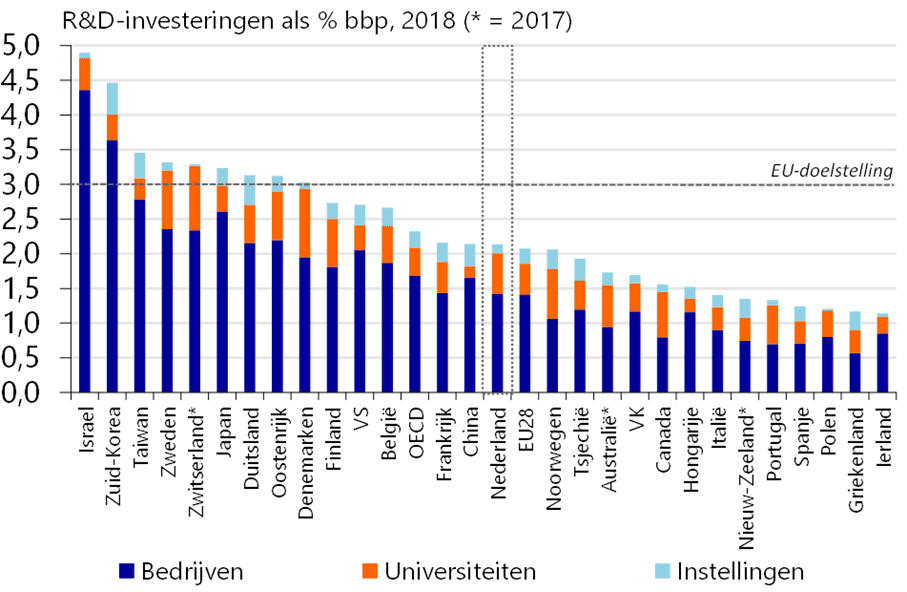
Een volgend kabinet moet R&D-investeringen door Nederlandse bedrijven aanjagen. Dat is een van de scenario’s die de onderzoeksafdeling van de Rabobank schetst in een vorige week verschenen onderzoek. Nederland loopt namelijk achter op het gebied van investeringen in R&D. Dat is zonde. Hoge investeringen in onderzoek en ontwikkeling betalen zich immers terug in onder meer een hogere economische groei. En dat is de komende jaren hard nodig, zo vinden ook wij bij HollandBIO.

R&D: economische groeimotor

R&D is een belangrijke determinant van economische groei aldus de Rabobank, omdat dit bijvoorbeeld bijdraagt aan een hogere arbeidsproductiviteit. Geen wonder dat politieke partijen als VVD, CDA en D66 oproepen om daar dan ook minstens 2,5% van ons bruto binnenlands product (BBP) in te steken. Alleen door de hoeveelheid geld die in innovatie wordt gestoken te vergroten, kan Nederland haar verdienvermogen blijven vergroten. Een volgend kabinet zou dus veel oog moeten hebben voor dit percentage.

Europese middenmoter

Nederland hangt in de Europese middenmoot als het aankomt op de hoeveelheid geld die we uitgeven aan R&D. De R&D investeringen in Nederland zijn op dit moment 2,1% van het BBP, de totale omvang van onze economie. Daarmee scoren we nipt beter dan het Europees gemiddelde, en ruim onder de doelstelling van 3% die de Europese Commissie voor ogen heeft.

De kenmerken van onze economie zijn mede debet aan dit relatief lage cijfer. Ons land kent een sterke dienstensector waarin R&D-investeringen relatief laag liggen. Maar dat is niet het hele antwoord. Rabobank becijferde ook de relatieve investeringen per sector. Daaruit blijkt dat de chemie- en farmasector in Nederland relatief weinig investeren in R&D in vergelijking met deze sectoren in andere landen. Dat kan beter, denken wij.

Publieke investeringen als vliegwiel voor private R&D

De Rabobank schetst verschillende wegen om het R&D-percentage te vergroten. HollandBIO is ervan overtuigd dat versterking van de inspanningen in bestaande, innovatieve sectoren in Nederland loont. In plaats van nieuwe sectoren opzetten die we in Nederland niet of nauwelijks kennen zoals automotive of computers, zouden we de chemie- en farmasector moeten verleiden meer in R&D te investeren in Nederland.

Veel van de ingrediënten voor een succesvolle versierpoging vanuit de overheid zijn aanwezig. Eerder schreven we al over de sterke kennisbasis die Nederland over de hele biotechbreedte kent. Meer investeringen losmaken, vraagt aan de ene kant om het beter benutten van deze kennis door soepeler kennis- en technologieoverdracht. Aan de andere kant zijn ook financieringsinstrumenten die aansluiten bij de behoefte van beloftevolle biotechbedrijven cruciaal. Dit blijkt ook uit het recente AWTI rapport en de Roland Berger studie die HollandBIO vorige week aan EZK-staatssecretaris Mona Keijzer overhandigde.

De Rabobank ziet legio mogelijkheden om R&D-investeringen door bedrijven op te krikken door middel van het Nationaal Groeifonds. Zo’n investeringspakket kan je volgens de Rabobank ook nog eens koppelen aan maatschappelijke uitdagingen als klimaatverandering, de energietransitie, de vergrijzing en stijgende zorgkosten of de ontwikkeling van toekomstige sleuteltechnologieën (waar biotechnologie er één van is, naast bijvoorbeeld kunstmatige intelligentie). Zoals jullie zullen begrijpen, past deze oproep tot het aanjagen van R&D-investeringen, het bijdragen aan duurzaamheid en gezondheid en het langdurig versterken van het Nederlandse innovatie- en verdienvermogen perfect bij biotech. Wij roepen het daarom nog maar een keer: investeer in biotech, innoveer je uit de crisis!

← #nieuws

Nieuw onderzoeksprogramma gloort aan de horizon: Horizon Europe opvolger van Horizon2020

Het Europese onderzoeksprogramma Horizon2020 was een groot succes voor Nederland. Ons land heeft met dit onderzoeks- en innovatieprogramma van de Europese Unie ongeveer €5 miljard aangetrokken, van de totaal €63,5 miljard aan onderzoeksgelden. Zo wordt HollandBIO-lid Mimetas als lichtend voorbeeld aangehaald als één van die Nederlandse bedrijven die Horizon2020-gelden hebben ontvangen. Horizon Europe wordt het nieuwe Horizon 2020.

De Horizon-programma’s zijn in het leven geroepen om wetenschappelijke kennis te vergroten en economische groei te versnellen. Inmiddels gloort er een nieuw Horizon-programma aan de horizon. Horizon Europe wordt het nieuwe Horizon 2020. De komende zeven jaar wordt er via dit programma €95,5 mld. beschikbaar gesteld voor ondernemers en wetenschappers; dat is 30% meer dan de Horizon2020. Op 18 maart vindt het kick-off event voor het thema gezondheid plaats. Hopelijk kan Nederland weer net zo goed gebruik maken van dit onderzoeksprogramma en daarmee onze horizon verbreden. Verder naar het kick-off event

← #nieuws

Apply for the Merck Advance Biotech Grant Program

Your promising molecule requires resources and support to realize its potential. The Merck Advance Biotech Grant Program is open to European* biotech companies, to help you accelerate to the clinic faster. Apply before March 12, 2021 for a chance to win bioprocessing**/Actives and Formulation products and consultation.

The Winner will receive €255,000 to be used for the purchase of the following:

  • 160,000€ in bioprocess technologies
  • 40,000€ in bioprocess consulting services
  • 40,000€ in Actives and Formulations catalogue portfolio for biomolecule formulation
  • 15,000€ in a full subscription to Emprove® Suite for a one-year period

*Austria, Belgium, Denmark, France, Finland, Germany, Ireland, Netherlands, Norway, Portugal, Spain, Sweden, Switzerland, and United Kingdom. – see official rules for eligibility.

**Excludes BioReliance® Services

Flyer: https://www.hollandbio.nl/wp-content/uploads/2021/03/SAS2192-End-of-Year-Grant-Program-Flyer_V7.pdf

← #nieuws

‘Nederland kan koploper biotechnologie worden’

, , ,

‘We hebben in Nederland de kennis, de ervaring én de handelspositie om in Europa koploper biotechnologie te worden. Toch weten we onze excellente kennis op dit moment nog te weinig te benutten. Daarom zijn er extra investeringen en betere wet- en regelgeving nodig om van Nederland het ‘Boston van Europa’ te maken’. Dat staat in de visie ‘Toekomstpact Biotechnologie Nederland 2025’ van een coalitie van VNO-NCW, branches, topsectoren en bedrijven in de biotechnologie. Maandag overhandigde VNO-NCW-voorzitter Ingrid Thijssen namens het bedrijfsleven het pact aan demissionair minister van Infrastructuur & Waterstaat Cora van Nieuwenhuizen.

30 miljard aan extra kansen

‘Biotechnologie is, samen met kunstmatige intelligentie, de motor van de vierde industriële revolutie. Zij is cruciaal voor het succes van onder andere de verduurzaming en de strijd tegen klimaatverandering. Daarnaast is zij belangrijk voor het toekomstig groeivermogen van onze economie. Uit onderzoek van McKinsey blijkt dat Nederland jaarlijks 30 miljard euro extra kan verdienen door de mogelijkheden van biotechnologie beter te benutten’, aldus het rapport.

4 actielijnen

Concreet stelt het bedrijfsleven vier actielijnen voor die het de komende jaren – samen met kennisinstellingen en overheden – graag verder uitwerkt.  Dat zijn: meer investeren in onderzoek, biotechnologie als speerpunt van ons investeringsklimaat, betere financiële ondersteuning van startups en scale-ups, en het moderniseren van wet- en regelgeving. Dat laatste om biotechnologische innovaties en ontwikkelingen bij te kunnen benen en niet achter internationale concurrenten te lopen.

Nationale coördinatie onderzoek

‘Wij steken ook de hand in eigen boezem: we moeten immers niet alleen vragen maar ook oplossingen aanbieden.’ De private partijen onderzoeken de mogelijkheid om, naar succesvol Vlaams model, een Nederlands Instituut voor de Biotechnologie op te richten. Dat coördineert zowel nationaal onderzoek, met een focus op het ontwikkelen van nieuwe producten en diensten ten behoeve van consument en patiënt, als financiering van innovatieve projecten en jonge biotech-bedrijven.

Bron: VNO-NCW (Nieuwsbericht)

← #nieuws

Biotech companies show to be resilient and see venture financing grow in 2020

, , ,

Biotechgate, the leading global biotech database, presents their annual Trend Analysis Report 2021 of the Dutch life sciences sector. The report shows the resilience of the Dutch biotech sector. Although the coronavirus had a negative impact on the amount of clinical trials, biotech companies attracted double the amount of venture financing compared to 2020. This growth in difficult economic times shows both the important societal and economic value of the sector.

A vibrant ecosystem
With many ground-breaking companies, world-class universities and an attractive business climate, the Netherlands is the perfect location for biopharmaceutical innovation in Europe. This is reflected in a vibrant ecosystem. Biotechgate currently lists 493 biotech companies, 140 medtech companies, 50 digital health companies and 42 pharma companies in the Netherlands. There are 160 products in preclinical phase and 116 products in the clinical phase.

Resilience in times of crisis
Dutch biotech companies have shown to be resilient in times of a crisis. The coronavirus had a negative impact on the amount of clinical trials, which dropped to 2013 levels. Even so, biotech businesses were still able to double the amount of venture financing. In total life science companies raised $620 million. Biotech companies accounted for the largest share of that number. $559,12 million was raised in 22 private equity rounds by biotech companies. The three biggest rounds were raised by Neogene Therapeutics ($110 million), Lava Therapeutics (83 million) and Mosa Meat ($74 million).

HollandBIO’s managing director Annemiek Verkamman is proud of the Dutch life sciences sector: “The life sciences sector really shows its strength during the corona crisis. The sector is able to produce vaccines against COVID-19 in an amazing short time period. It also shows its capability to attract an extensive amount of venture financing for R&D, due to its non-cyclic character. Investing in life sciences not only contributes to sustainability, health and economic growth, but also helps the to boost our economies out of the corona crisis.” 

Download full report here.