From wait and see to fund and lead: A roundtable on financing Europe’s biotech frontrunners
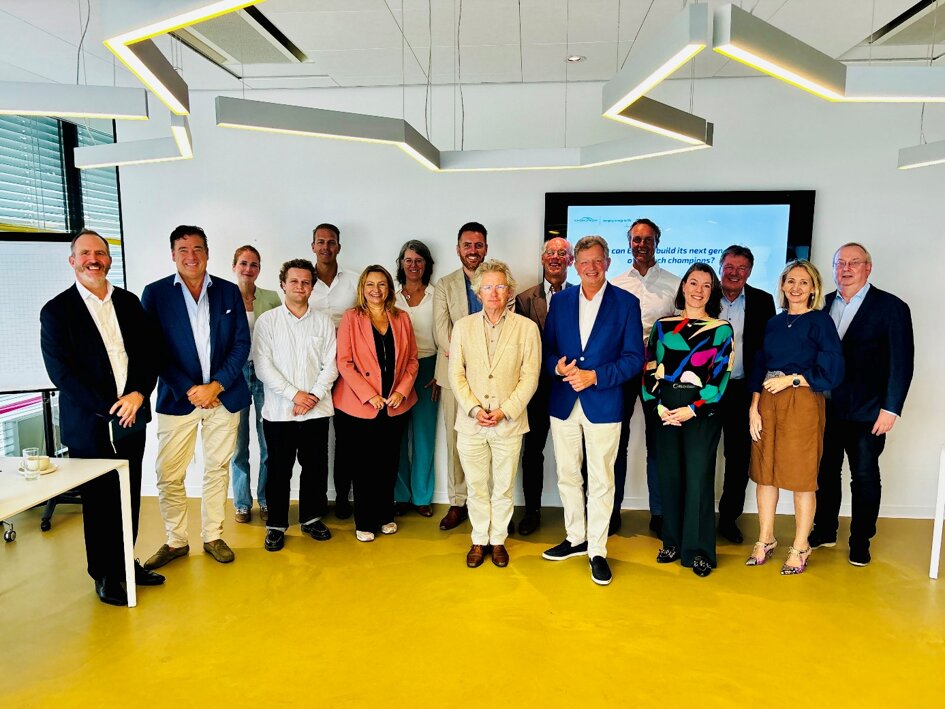
On 14 September, hollandbio joined a diverse group of biotech leaders for a roundtable discussion with EIC President Michiel Scheffer. The conversation, hosted by biotech company Khondrion in Nijmegen, focused on a key question: how can Europe build the next generation of biotech frontrunners?
Khondrion is dedicated to developing treatments for mitochondrial diseases, a group of often fatal rare diseases that can manifest at a very young age and for which no treatment currently exists that can slow the underlying disease process or its progression. Frank Alsemgeest left the room in silence as he shared what this means for families like his own: his son Robbe passed away at the age of three due to a mitochondrial disease.
Founder Jan Smeitink has independently guided the company from an academic concept to Phase III clinical development, a rare achievement within the Dutch biotech ecosystem. Yet bringing this innovation through the final stages of development and ultimately to patients requires tens of millions of euros in additional funding.
For Khondrion and other translational biotech frontrunners, such funding is far from readily available, especially in Europe. The challenge concerns a rare disease within a largely unexplored therapeutic field, despite an undeniable medical need. Every step from laboratory to patient is uncharted territory and must be designed and validated from scratch, from animal models and biomarkers to clinical endpoints. These pioneers often find themselves trapped in a “circle of wait and see,” where public and private investors, as well as pharmaceutical companies, follow developments with great interest, while waiting for someone else to make the first move. In the meantime, precious time is lost.
The status quo is all too familiar: Europe excels at generating world-class scientific discoveries and start-ups, yet struggles to scale them and capture their economic and societal value. The reason is simple: almost every key condition for biotech innovation is better organised elsewhere in the world.
The roundtable, moderated by biotech pioneer Ronald Brus, focused on precisely this challenge: how can we ensure that biotech frontrunners succeed in Europe rather than seeking opportunities abroad? Such as in the United States, where capital is significantly more abundant and investors have a greater appetite for risk. Or in China, where development can move at remarkable speed and, for now, at a fraction of the cost. Or South Korea, which has deliberately rolled out the red carpet for biotech innovation and is currently reaping the rewards.
The discussion made one thing clear: there is no silver bullet. Success requires an integrated approach. This includes fostering a more entrepreneurial culture, better aligning existing funding instruments and conditions with the unique characteristics of biotech innovation, and unlocking greater pools of capital, including pension fund investments and more attractive conditions for European IPOs. Equally important are faster and simpler regulatory pathways and an attractive market environment. Several ongoing European initiatives, such as the Biotech Act and the Capital Markets Union, provide valuable opportunities to strengthen these critical framework conditions.
The European Innovation Council (EIC), through its broad range of funding instruments that biotech companies already rely on extensively, plays a pivotal role in this. However, it is essential that public investors, including the EIC and national institutions such as Invest-NL, align more closely with the realities and needs of translational biotech frontrunners. For example, by offering greater support for later development stages and by taking a broader view of private investors, they can play a crucial role in mobilising and unlocking the patient, long-term capital these companies require.
By creating the right conditions, Europe can give its translational biotech frontrunners the momentum they need to succeed and ensure that European patients are among the first to benefit from the treatments they and their loved ones have been waiting for for so long.